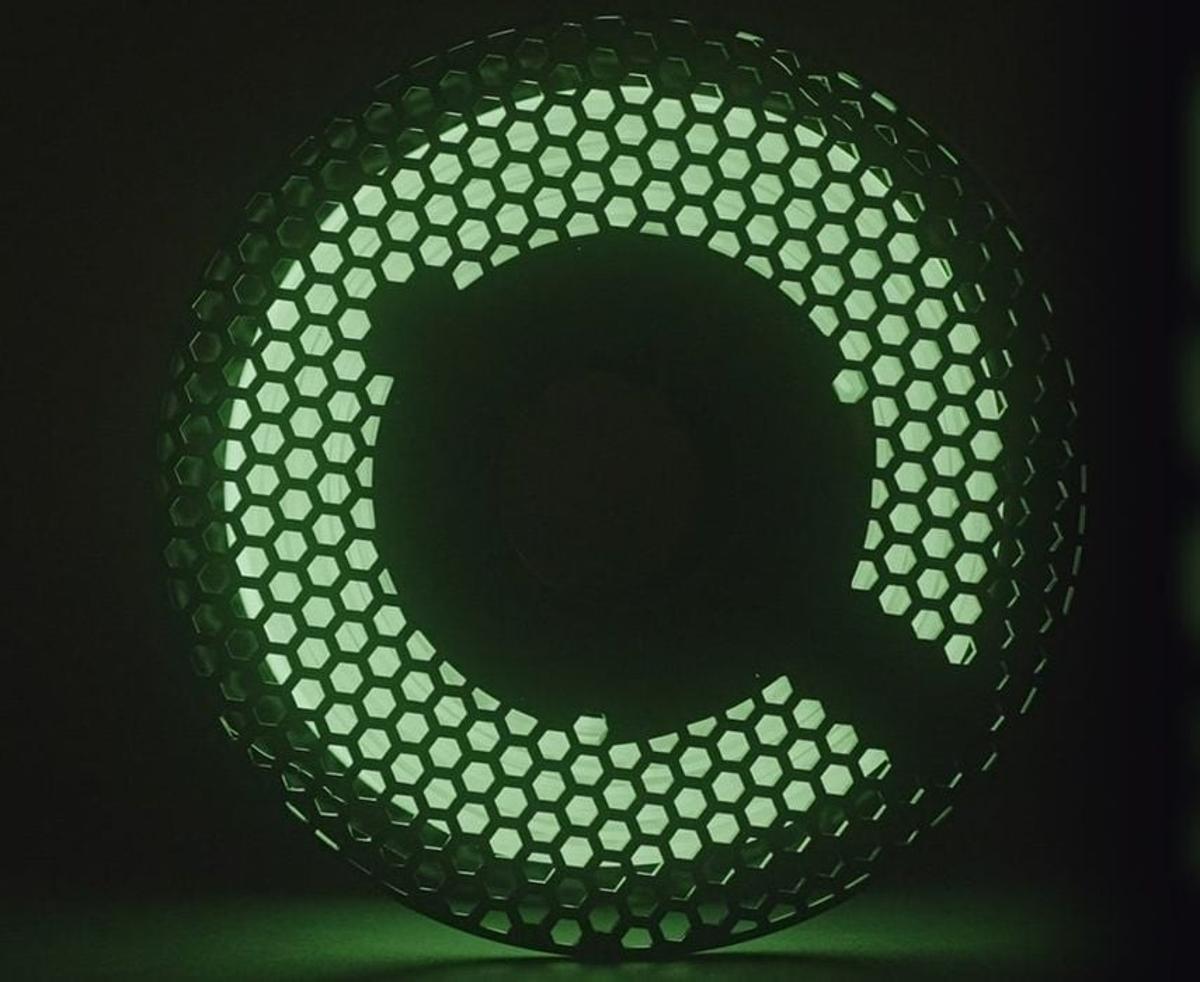
Prusa Launches Highly Abrasive PETG Ultraglow Green
•February 25, 2026
0
Why It Matters
The filament opens new possibilities for durable, illuminated components while imposing higher hardware maintenance costs, reshaping the specialty filament market.
Key Takeaways
- •Brightest glow‑in‑dark PETG claimed by Prusa
- •Uses abrasive strontium aluminate pigment
- •Requires hardened steel or DiamondBack nozzles
- •Premium price: $83 per 800 g spool
- •Ideal for functional parts, not casual prints
Pulse Analysis
Glow‑in‑the‑dark filaments have long been a niche novelty, typically limited to PLA blends that fade quickly after charging. Prusa’s Ultraglow Green disrupts that paradigm by leveraging PETG’s superior toughness and temperature resistance, combined with a maximal loading of strontium aluminate—a non‑toxic, water‑stable phosphorescent pigment. This chemistry delivers a brighter, longer‑lasting glow that can be charged with standard UV sources, positioning the material for applications beyond toys, such as safety markers, tool handles, and low‑light indicators in industrial prototypes.
The trade‑off for this performance is significant hardware wear. Strontium aluminate behaves like liquid sandpaper, rapidly eroding brass nozzles and degrading PTFE liners. Prusa recommends 0.6 mm hardened steel or E3D DiamondBack nozzles to mitigate clogging and prolong nozzle life, and advises users to monitor extruder gear wear. At $83 per 800 g spool, the filament sits at a premium price point, reflecting both its specialty formulation and the anticipated consumable replacement costs. Consequently, it appeals primarily to experienced makers accustomed to abrasive filaments such as carbon‑filled nylon, who already factor nozzle and tube replacements into their workflow.
Looking ahead, independent testing will be crucial to validate Prusa’s brightness claims over extended periods and to quantify real‑world nozzle lifespan. If community data confirms sustained luminescence and manageable wear rates, Ultraglow Green could set a new benchmark for functional, illuminated 3D‑printed parts. Early adopters may leverage the material for safety‑critical prototypes, low‑visibility signage, and custom electronics housings, while casual users might reserve it for accent prints. The filament’s success will hinge on balancing its visual impact against the operational costs of hardened hardware.
Prusa Launches Highly Abrasive PETG Ultraglow Green
0
Comments
Want to join the conversation?
Loading comments...