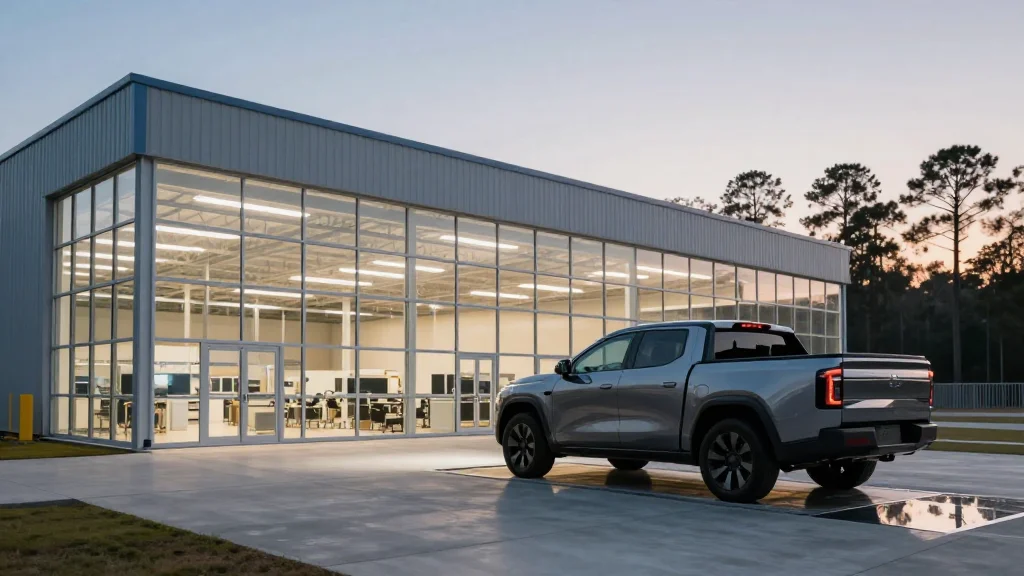
Rivian Cuts DOE Loan to $4.5 B, Boosts Georgia Plant Capacity to 300,000 Vehicles

Companies Mentioned
Why It Matters
Rivian’s financing restructure illustrates how emerging EV makers are adapting to a shifting policy environment. By accepting a smaller DOE loan while expanding the first‑phase capacity, Rivian reduces its reliance on federal subsidies yet seeks to achieve economies of scale that are essential for price competitiveness as tax credits fade. The move also reshapes the U.S. auto supply chain. A 300,000‑unit Georgia plant will draw parts, labor, and logistics resources to the Southeast, potentially spurring regional supplier development and creating a new hub that competes with established manufacturers in the Midwest and West.
Key Takeaways
- •DOE loan reduced to $4.5 billion, down from $6.6 billion
- •Georgia factory will be a single‑phase plant with 300,000‑unit annual capacity
- •Combined U.S. capacity now 515,000 vehicles, 100,000 less than earlier target
- •Rivian to draw loan funds in early 2027; production at Georgia site slated for late 2028
- •Uber pledged $300 million upfront and $250 million later for R2 robotaxis; Volkswagen committed $1 billion with up to $5.8 billion contingent on milestones
Pulse Analysis
Rivian’s decision to pare back the DOE loan while simultaneously enlarging the initial production footprint reflects a nuanced risk‑adjusted strategy. The company is betting that a larger first‑phase plant will deliver sufficient volume to amortize fixed costs faster, thereby narrowing the gap between its cost structure and that of legacy automakers. This approach also cushions Rivian against potential policy reversals; a smaller federal loan reduces political exposure while still securing the capital needed for critical tooling and construction.
From a competitive standpoint, the move positions Rivian to leverage its partnership ecosystem more effectively. The $300 million Uber investment ties directly to the R2 robotaxi program, creating a guaranteed revenue stream that can help offset the near‑term automotive gross‑profit loss highlighted by McDonough. Meanwhile, Volkswagen’s staged investment provides both cash and a validation of Rivian’s software platform, which could become a differentiator as EVs increasingly rely on over‑the‑air updates and advanced driver‑assist systems.
Looking forward, the real test will be whether Rivian can translate the expanded capacity into sustained sales once the federal tax credit expires. The company’s ability to keep the Georgia plant on schedule, manage supply‑chain volatility, and meet the performance milestones tied to its strategic partners will determine if the $4.5 billion loan is sufficient or if additional financing will be required for a second phase. Investors will be watching the Q2 delivery numbers and the timing of Uber’s capital commitments closely, as those data points will signal whether Rivian’s revised plan can deliver the cost efficiencies it promises.
Rivian Cuts DOE Loan to $4.5 B, Boosts Georgia Plant Capacity to 300,000 Vehicles
Comments
Want to join the conversation?
Loading comments...