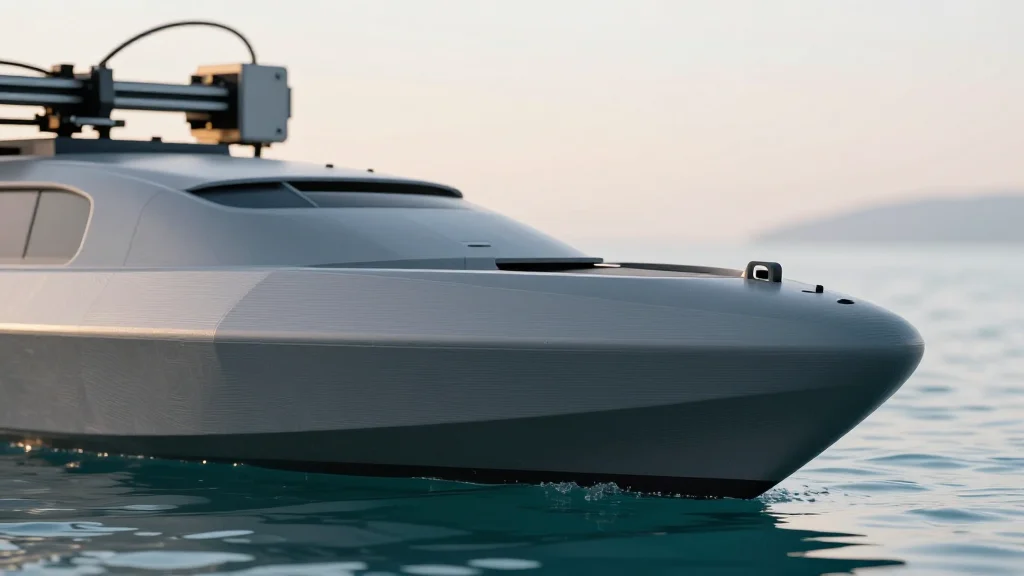
SeaRush Project Takes 3D Printed USV Testbed From Concept to Sea in 5-Month Timeframe
Why It Matters
SeaRush proves that advanced manufacturing can compress USV development cycles, giving navies and commercial operators faster access to adaptable maritime platforms. The approach signals a shift toward cost‑effective, modular shipbuilding that can keep pace with evolving security and logistics needs.
Key Takeaways
- •3D printed hull built in under a week
- •Prototype launched after only five months of development
- •Project unites defense, academia, and industry for rapid USV innovation
- •Flexible hull design enables quick system swaps and cost control
- •IMPAD Boats advancing DEMEX remelt tech for stronger maritime parts
Pulse Analysis
The maritime sector is witnessing a paradigm shift as uncrewed surface vessels move from laboratory concepts to operational assets at unprecedented speed. SeaRush’s five‑month timeline demonstrates how coordinated effort among defense agencies, research institutes like MARIN, and agile manufacturers can compress traditional shipbuilding cycles that once spanned years. By treating the USV as an experimental testbed, stakeholders can iterate on propulsion, communications and autonomy in real‑world conditions, accelerating the feedback loop essential for reliable autonomous operations.
At the heart of this acceleration is additive manufacturing. 3D printing the hull in less than a week not only slashes lead times but also introduces design flexibility unheard of in conventional composites. Interchangeable modules allow rapid reconfiguration for different mission sets, while cost control is achieved through material efficiency and reduced tooling. IMPACD Boats’ partnership with CEAD and the adoption of LEAM Technologies’ DEMEX remelt process further enhance tensile strength of Z‑axis layers by roughly 30%, delivering structural integrity comparable to traditional builds without the weight penalty.
The broader implications extend beyond the Dutch navy. Faster, modular USV production lowers entry barriers for commercial operators seeking autonomous patrol, environmental monitoring or cargo transport solutions. For defense, the ability to field adaptable platforms quickly can address emerging threats and integrate new sensor suites without lengthy redesigns. As more nations and private firms adopt similar rapid‑prototype pipelines, the maritime industry is poised for a wave of innovation that blends cutting‑edge materials science with agile engineering practices, reshaping how vessels are conceived, built, and deployed.
SeaRush project takes 3D printed USV testbed from concept to sea in 5-month timeframe
Comments
Want to join the conversation?
Loading comments...