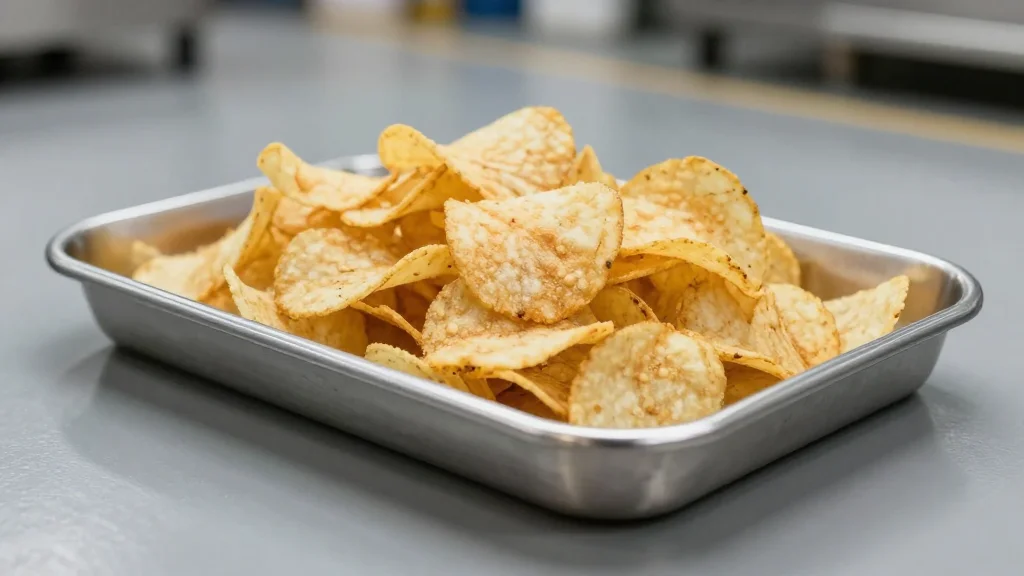
Shearer's Foods Launches Potato Chip Line at Dayton Plant, Expanding $106M Facility

Companies Mentioned
Why It Matters
The launch of a potato‑chip line at Shearer's Dayton plant illustrates how private‑brand snack makers are reshaping U.S. manufacturing by investing in domestic capacity and repurposing legacy industrial sites. By bringing production closer to major retail markets, Shearer's can reduce shipping costs, improve supply‑chain resilience, and respond faster to shifting consumer tastes. The expansion also highlights the broader economic impact of converting former automotive facilities into food‑production hubs, creating skilled jobs in regions that have experienced manufacturing decline. For the snack industry, the move signals a competitive shift toward greater vertical integration. As retailers demand more private‑label options, manufacturers like Shearer's that can control the entire production process—from raw potatoes to packaged chips—gain leverage in pricing negotiations and can more readily meet sustainability targets. The Dayton line therefore serves as both a capacity boost and a strategic platform for future product innovation.
Key Takeaways
- •Shearer's Foods began potato‑chip production at its Dayton, Ohio Center of Excellence on April 27, 2026.
- •The Dayton line adds a new capability to the $106 million, 390,000‑sq‑ft former GM paint shop converted in early 2025.
- •Shearer's produced over 350 million pounds of potato chips in the prior year, underscoring the scale of its private‑brand business.
- •The company’s Moraine plant opened in December, projected to employ 300+ workers and output 36 million pounds of chips annually.
- •Shearer's now operates nearly 20 facilities across the U.S. and Canada, covering a full range of salty snack categories.
Pulse Analysis
Shearer's aggressive expansion into potato‑chip manufacturing at Dayton reflects a broader strategic pivot among private‑brand snack producers: own more of the value chain to mitigate external shocks. The repurposing of a former GM paint shop is emblematic of a post‑pandemic manufacturing renaissance, where large, underutilized industrial spaces are being retrofitted for food production. This not only revitalizes local economies but also aligns with sustainability goals by reducing the carbon footprint associated with long‑haul freight.
Historically, snack manufacturers have relied heavily on third‑party co‑packers in low‑cost regions. Shearer's decision to double‑down on U.S. facilities suggests confidence that domestic labor costs can be offset by efficiencies gained through automation and proximity to key retail hubs. The company's emphasis on a "Center of Excellence" hints at a future where the Dayton site could become a testbed for advanced packaging, AI‑driven quality control, and rapid flavor development—capabilities that could be rolled out across its network of 20 plants.
Looking ahead, the success of the Dayton line will likely influence peers in the sector. If Shearer's can demonstrate that a $106 million investment yields competitive unit economics and meets retailer demand for private‑label snacks, we may see a wave of similar conversions across the Midwest. The key variables will be labor availability, the speed of technology adoption, and the ability to sustain demand in a market where snack consumption is increasingly health‑conscious. For now, Shearer's expansion stands as a tangible indicator that U.S. manufacturing is re‑gaining relevance in the snack industry.
Shearer's Foods Launches Potato Chip Line at Dayton Plant, Expanding $106M Facility
Comments
Want to join the conversation?
Loading comments...