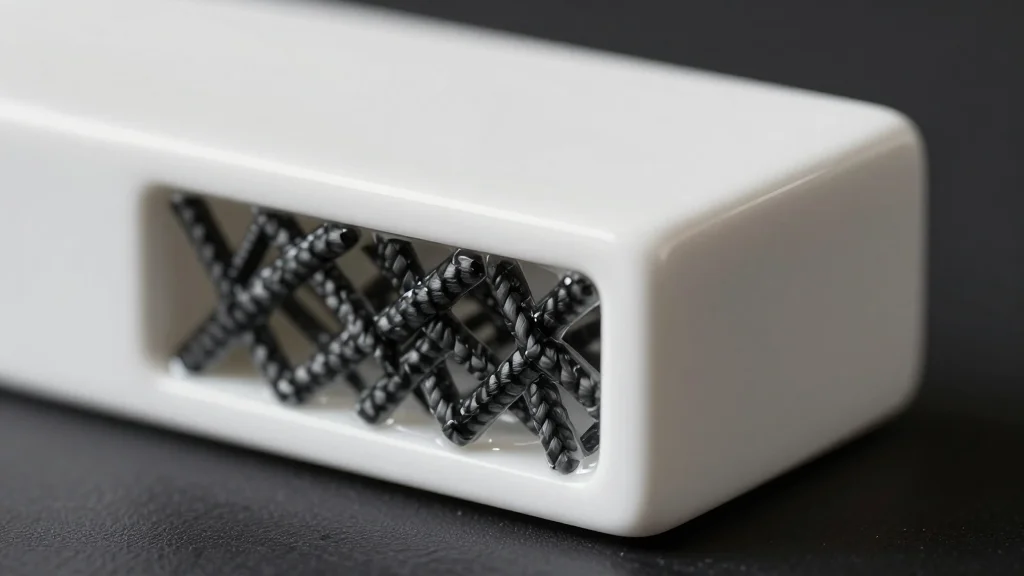
Swiss Researchers Develop Matrix First Concept for 3D Printed Continuous Fiber Ceramic Structures
Why It Matters
Matrix First creates a new design paradigm that merges architecture, material, and reinforcement, enabling lighter, stronger components for extreme‑environment markets. It could accelerate adoption of ceramic‑composite hybrids in aerospace, power generation, and other high‑performance fields.
Key Takeaways
- •Matrix First embeds reinforcement channels during ceramic printing.
- •Continuous carbon fibers injected via CFIP improve strength.
- •Process retains ceramic thermal and wear resistance.
- •Enables lightweight, high‑temperature components for aerospace, energy.
- •Open to collaborations for extreme‑environment demonstrators.
Pulse Analysis
Additive manufacturing has long struggled to marry the brittleness of ceramics with the toughness required for demanding applications. Traditional post‑process reinforcement adds weight and complexity, often compromising the ceramic’s heat‑resistant properties. Matrix First flips this model by integrating reinforcement pathways directly into the printed geometry, allowing engineers to tailor load‑bearing routes before the material solidifies. This approach leverages laser powder‑bed fusion to create a polymer scaffold that is later transformed into a dense ceramic matrix, preserving the fine microstructure essential for high‑temperature performance.
The continuous fiber injection process (CFIP) developed by Reinforce3D is the linchpin that turns the concept into a practical reality. By simultaneously feeding carbon fibers and epoxy resin into the pre‑designed channels, the method ensures uniform fiber distribution and strong interfacial bonding without the need for manual lay‑up. The resulting hybrid exhibits a synergistic blend of ceramic hardness and composite ductility, delivering superior strength‑to‑weight ratios. Early prototypes demonstrate significant improvements in flexural strength and impact resistance, while maintaining the ceramic’s ability to withstand temperatures exceeding 1,200 °C (≈2,200 °F).
Industries that operate under extreme thermal and mechanical stresses stand to benefit most. In aerospace, lighter turbine blades or heat shields could improve fuel efficiency and payload capacity. Energy sectors, such as concentrated solar power or nuclear reactors, could adopt these components for durable, corrosion‑resistant heat exchangers. The open invitation for demonstrator collaborations signals a strategic push to validate the technology across real‑world use cases, potentially accelerating its transition from laboratory to production. As the market seeks materials that combine resilience, lightweighting, and thermal stability, Matrix First positions itself as a compelling solution for the next generation of high‑performance engineering.
Swiss researchers develop Matrix First concept for 3D printed continuous fiber ceramic structures
Comments
Want to join the conversation?
Loading comments...