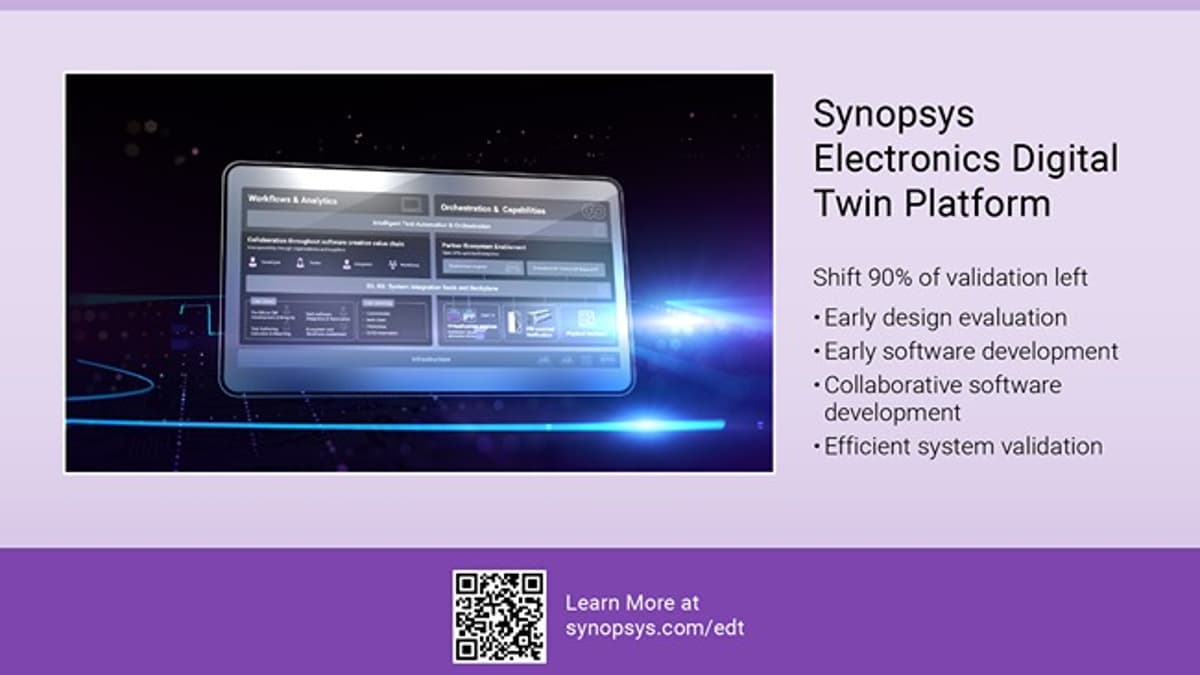
Synopsys Launches Electronics Digital Twin Platform
•March 10, 2026
0
Why It Matters
By shifting software development left, the eDT Platform cuts development cycles and improves quality, giving automotive firms a competitive edge in an increasingly software‑centric market.
Key Takeaways
- •Open eDT platform targets automotive software development
- •Enables software coding before hardware availability
- •Cloud‑based labs integrate Synopsys, Vector SIL Kit, partners
- •Supports SaaS or BYOC on AWS Graviton4
- •Enhances collaboration and continuous integration testing
Pulse Analysis
Digital twins have become a strategic asset for industries where hardware cycles are long and software complexity is rising. In automotive, the pressure to deliver over‑the‑air updates and autonomous features forces OEMs to prototype software earlier than ever. Synopsys’ eDT Platform answers this need by providing a virtualized silicon environment that mirrors real ECUs, enabling engineers to write, test and debug code without waiting for physical chips. This shift‑left approach not only accelerates development but also uncovers integration issues when they are cheaper to fix.
The eDT Platform differentiates itself through its modular eDT Labs, which bundle Synopsys’ AI‑enhanced verification tools, Vector’s open‑source SIL Kit for system composition, and a curated set of partner models and IP. Users can provision labs via a role‑based portal, connect to existing CI pipelines through APIs, and choose compute models ranging from fully managed SaaS to bring‑your‑own‑cloud on AWS Graviton4 processors. Such flexibility lets organizations scale resources on demand while maintaining security and compliance, a crucial factor for automotive supply chains that span multiple tiers and geographies.
From a business perspective, the platform positions Synopsys as a central hub in the emerging automotive software ecosystem. By lowering the barrier to early software validation, OEMs can reduce prototype costs, accelerate time‑to‑market, and improve software quality—key differentiators as vehicles become rolling data centers. Competitors offering fragmented simulation tools may struggle to match the integrated, cloud‑native experience Synopsys delivers, potentially reshaping vendor relationships across the automotive value chain.
Synopsys launches electronics digital twin platform
0
Comments
Want to join the conversation?
Loading comments...