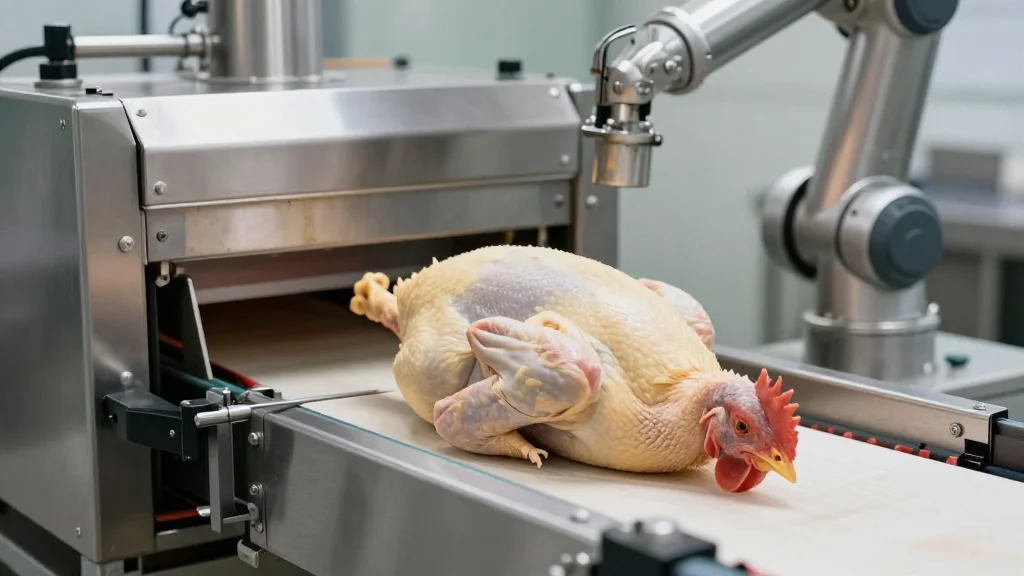
The Big Bird Challenge Is Testing Poultry Plant Design
Why It Matters
The trend forces processors to invest in durable, flexible equipment to avoid bottlenecks and rising maintenance costs, directly impacting profitability and supply‑chain reliability.
Key Takeaways
- •Larger birds increase mechanical wear, demanding more durable equipment
- •Baader 661 deboner handles 3.5‑12 lb birds, saving 30 ft space
- •Automation cuts labor strain, may slightly lower yield vs. hand deboning
- •Plant lines must expand shackle spacing and conveyor widths for big birds
- •Future upgrades rely on modular design and AI‑driven vision systems
Pulse Analysis
The U.S. poultry sector has quietly reshaped its production profile over the past two decades by favoring heavier birds rather than sheer headcount. USDA figures show a steady rise in average live weight, pushing the compound annual growth rate of total pounds to roughly 1.6 %. Birds exceeding 7.8 lb now make up a noticeable share of the market, forcing processors to revisit line layouts, equipment spacing, and structural robustness. Legacy plants, originally built for smaller carcasses, encounter bottlenecks in scalding, evisceration and chilling as mechanical stresses climb.
Equipment manufacturers are responding with machines that blend higher throughput, durability and a compact footprint. Baader’s 661 Breast Deboner, for example, processes front halves from 3.5 lb to 12 lb at 85 pieces per minute while shaving 30 ft of floor space and requiring only two operators. Cantrell‑Gainco customers are widening hoppers, expanding conveyor belts and increasing shackle spacing to accommodate the broader size spectrum. Automation mitigates worker fatigue and stabilizes line speed, yet the trade‑off can be a modest dip in yield compared with skilled hand deboning, a balance plants must manage.
Looking ahead, flexibility will dominate plant investment decisions. OEMs are embedding modular architectures and AI‑driven vision systems such as Baader’s ClassifEYE to capture real‑time bird measurements and adjust cutting parameters on the fly. This data‑centric approach promises lower giveaway, consistent portioning and easier scalability for future size shifts. Processors that allocate space for modular upgrades and integrate predictive maintenance will protect total cost of ownership while staying competitive in a market where retailer portion specifications increasingly favor larger birds.
The big bird challenge is testing poultry plant design
Comments
Want to join the conversation?
Loading comments...