The End of Programming? Natural Language Interfaces in Industrial Robotics
Why It Matters
By allowing non‑experts to control robots via everyday language, the technology can accelerate smart‑manufacturing adoption, reduce programming overhead, and enhance flexibility in high‑precision inspection processes.
Key Takeaways
- •LLMs translate spoken commands into ROS task sequences.
- •Framework adapts to obstacles, proposing alternative actions autonomously.
- •Voice‑driven inspection reduces need for pre‑programmed routines.
- •Safety and traceability remain critical for metrology deployments.
- •Real‑time LLM inference must meet tight robotic control deadlines.
Pulse Analysis
The research consortium led by Huawei Noah’s Ark Lab, Technical University of Darmstadt, and ETH Zurich has unveiled a framework that couples large language models with the Robot Operating System. By feeding natural‑language commands into an LLM, the system parses intent, decomposes tasks, and hands the resulting action plan to ROS for perception, planning, and actuation. This bridge eliminates the traditional code‑first workflow, allowing operators to speak instructions such as “pick up the red object and place it in the box.” The architecture’s three‑layer design—language understanding, task planning, and execution—creates a modular pipeline that can be retrofitted onto existing robotic cells.
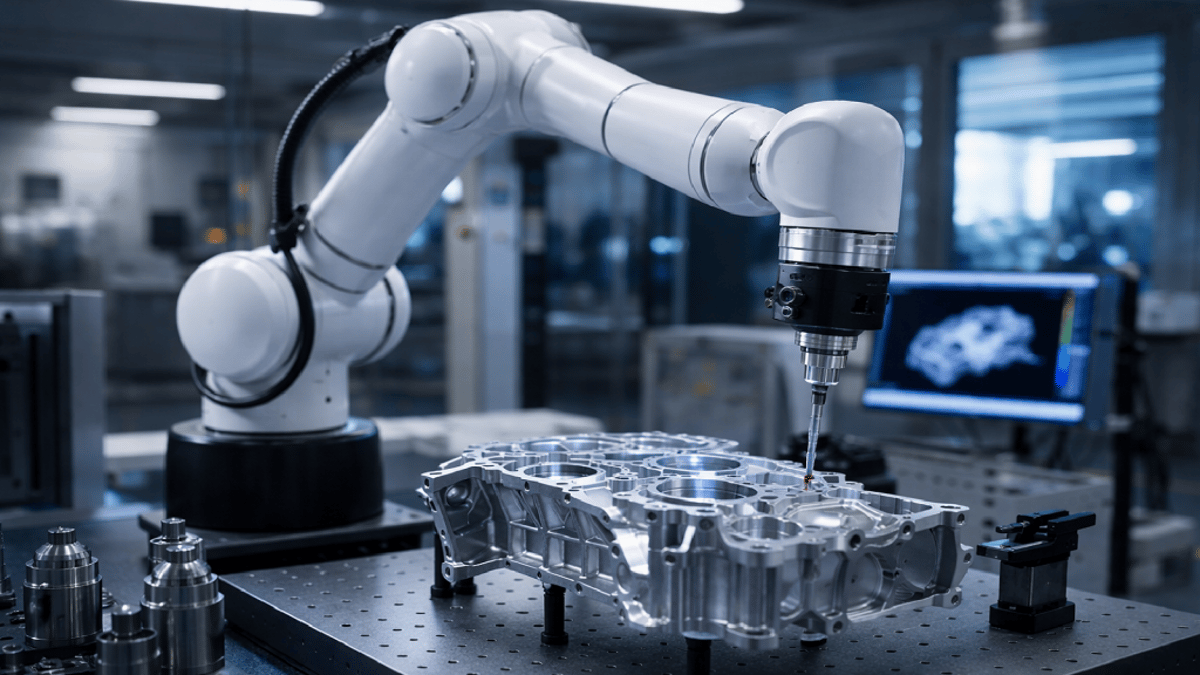
For the metrology sector, the ability to issue voice‑driven inspection commands could reshape how coordinate‑measuring machines and robotic inspection stations are programmed. Instead of writing scripts for each part geometry, technicians can simply ask the system to “measure all critical dimensions and generate a report,” prompting the robot to select appropriate sensors, adjust probing strategies, and log results automatically. This lowers the barrier for less‑experienced staff, accelerates line changeovers, and supports adaptive measurement strategies that react to real‑time part variations. The approach dovetails with broader digital‑metrology trends that embed AI reasoning directly into precision hardware.
Despite its promise, deploying LLM‑driven robots in production raises hard questions about reliability, safety, and traceability. Natural language is ambiguous, so the system must incorporate robust validation layers that confirm each generated motion before execution, especially in environments where a millimeter error can cause costly rework. Real‑time inference also demands optimized models or edge‑accelerators to meet the sub‑millisecond latency required by control loops. As these technical hurdles are addressed, the framework points toward cognitive robotics—machines that not only follow commands but understand context, reason about alternatives, and collaborate seamlessly with human operators.
The End of Programming? Natural Language Interfaces in Industrial Robotics
Comments
Want to join the conversation?
Loading comments...