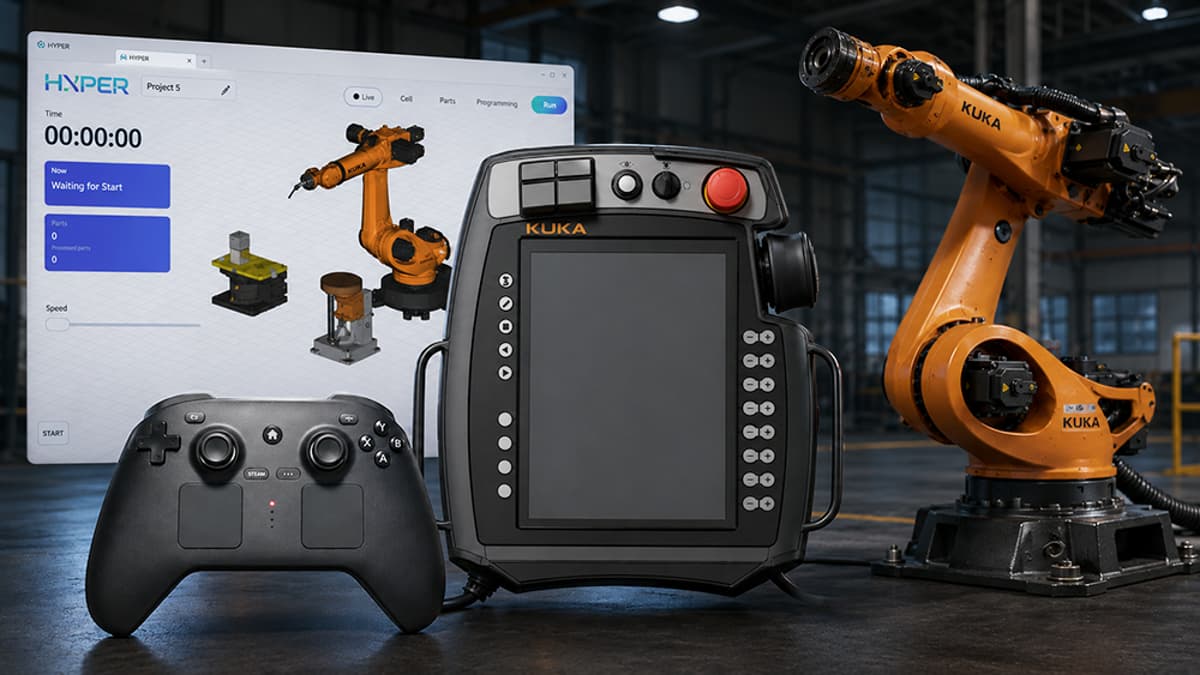
The Steam Controller and an Industrial Robot: An Unexpected Intersection
Companies Mentioned
Why It Matters
The solution gives manufacturers an inexpensive, instantly replaceable tactile control option, boosting operator confidence and cutting production downtime without compromising safety compliance.
Key Takeaways
- •Gaming controllers deliver analog input for precise robot jogging
- •Controllers are rugged, mass‑produced, and replaceable within hours
- •Wireless design lets operators move freely around the robot cell
- •ENCY Hyper maps controller signals to robot motion via digital twin
- •No safety compromise; emergency stops stay on dedicated hardware
Pulse Analysis
Industrial robot programming has long wrestled with the trade‑off between visual interfaces and the need for tactile feedback. Touchscreen workstations excel at configuration and monitoring, yet they lack the nuanced input required for jogging a six‑axis arm carrying a 50 kg payload. Traditional teach pendants solve this with physical buttons, 6‑D mice and emergency stops, but they add cost, maintenance overhead, and often tie operators to a single workstation. ENCY Hyper’s software‑only model initially faced the same limitation—operators needed a physical control without the company becoming a hardware vendor.
Enter the consumer gaming controller, a device honed over decades for durability, ergonomics and analog precision. Built to survive drops, spills and millions of button cycles, these controllers already meet the ruggedness standards of industrial environments. Their stick geometry, trigger resistance and button spacing have been refined through global user testing, delivering the fine‑grained motion control that robot teaching demands. Because they are mass‑produced, replacements are available at local retailers within minutes, dramatically reducing downtime compared with proprietary pendants. Wireless connectivity further liberates operators, allowing them to stand at a comfortable distance from the robot while maintaining a seamless control loop.
ENCY Hyper integrates the controller via standard operating‑system drivers, translating stick deflections into continuous motion commands through a digital twin before dispatching them to the robot’s native driver. This architecture preserves all safety interlocks—emergency stops, limit switches and enable signals remain on certified hardware—while the controller handles only the nuanced jog inputs. The result is a cost‑effective, flexible control layer that can be adopted across KUKA, FANUC and other platforms without additional certification burdens. As more manufacturers recognize the viability of repurposing consumer devices, the line between industrial and consumer ergonomics blurs, promising faster innovation cycles and lower entry barriers for advanced automation.
The Steam Controller and an Industrial Robot: An Unexpected Intersection
Comments
Want to join the conversation?
Loading comments...