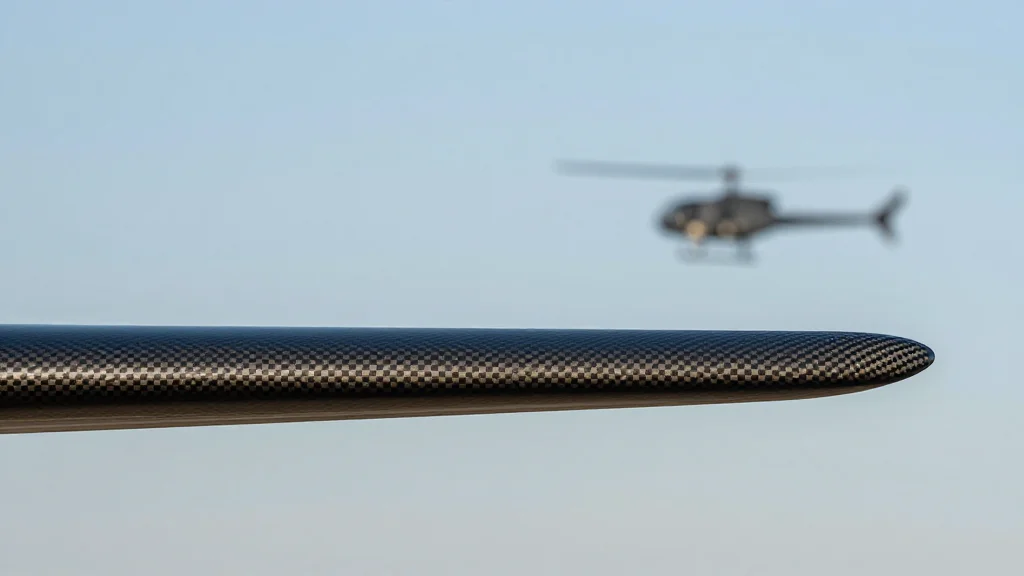
Uavos Supplies Rotor Blades to DARPA Lift Challenge Teams
Why It Matters
The Uavos blades give DARPA teams a tangible performance edge in heavy‑lift unmanned rotorcraft, while Bcomp’s natural‑fiber solutions prove that sustainable composites can meet automotive manufacturing standards, accelerating industry adoption.
Key Takeaways
- •Uavos supplies carbon‑fiber rotor blades to DARPA Lift Challenge teams
- •Blades use multi‑cross‑layer tech, NACA 23012 airfoil, 3,000‑hour life
- •Optimized blade twist cuts power use, boosts unmanned heavy‑lift endurance
- •Bcomp’s ampliTex flax composites appear on Kia Vision Meta Turismo’s exterior
- •Flax‑reinforced bumpers work with injection molding for scalable production
Pulse Analysis
The Defense Advanced Research Projects Agency’s Lift Challenge pushes the envelope of unmanned heavy‑lift capability, and Uavos’s carbon‑fiber rotor blades are a critical enabler. By leveraging a multi‑cross‑layer layup and the aerodynamically efficient NACA 23012 profile, the blades maintain geometric stability under extreme loads while trimming power draw. Independent testing confirming a 3,000‑hour lifespan gives teams confidence that their prototypes can sustain extended flight campaigns, a key differentiator in a competition where payload‑to‑weight ratios define success.
Meanwhile, Bcomp’s ampliTex flax‑reinforced fabrics are moving beyond interior trims into the structural skin of Kia’s Vision Meta Turismo concept. The material’s ability to be injection‑molded aligns with existing automotive production lines, eliminating costly retooling. Its circularity credentials—derived from renewable flax fibers—address growing consumer and regulatory pressure for greener vehicles. By showcasing the composites on front, rear, and side bumpers, Kia demonstrates that natural‑fiber technology can meet durability and aesthetic demands while expanding the palette of colors and finishes available to designers.
Together, these developments signal a broader convergence of defense and automotive sectors around lightweight, high‑performance composites. Carbon‑fiber and natural‑fiber solutions are no longer niche; they are becoming mainstream options for improving efficiency, reducing emissions, and extending operational life. As manufacturers seek to cut weight without sacrificing strength, the market for advanced composites is poised for rapid growth, driven by both government contracts and consumer‑focused sustainability goals.
Uavos supplies rotor blades to DARPA Lift Challenge teams
Comments
Want to join the conversation?
Loading comments...