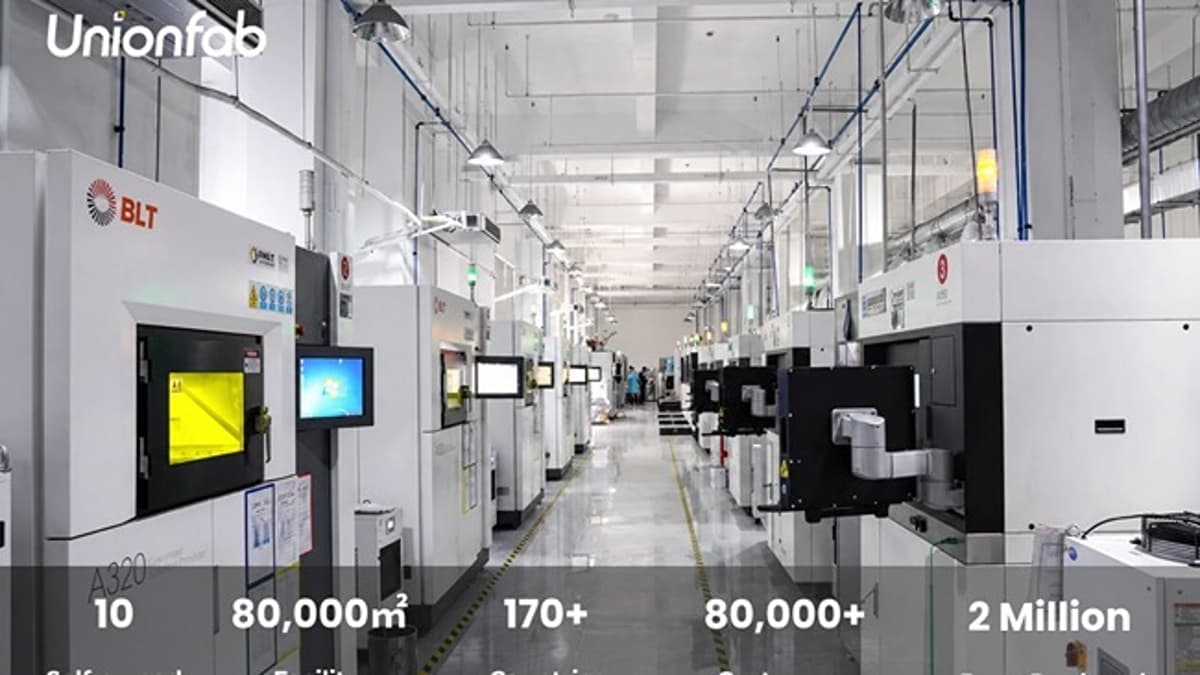
Unionfab Expands Industrial Metal 3D Printing Services
Why It Matters
The accelerated turnaround and cost reductions make metal additive manufacturing viable for low‑volume production, opening new opportunities for aerospace, automotive and hardware developers. This shift could reshape supply chains by reducing reliance on traditional machining and long‑lead‑time suppliers.
Key Takeaways
- •Unionfab cuts low‑volume metal part lead time to five days.
- •Multi‑laser SLM systems boost printing efficiency up to 40%.
- •AI pre‑compensation enables 0.6 mm layers while maintaining quality.
- •Over 100 industrial metal printers support 12 alloy families.
- •End‑to‑end service spans 3D printing to CNC and injection molding.
Pulse Analysis
Metal additive manufacturing is moving beyond high‑end prototyping toward reliable low‑volume production, driven by demand for lightweight structures and complex geometries. Unionfab’s recent geographic expansion taps into North American and European markets where manufacturers seek faster iteration cycles. By pairing multi‑laser selective laser melting (SLM) hardware with an AI‑optimized workflow, the company shortens part‑to‑delivery windows from weeks to days, positioning metal 3D printing as a competitive alternative to traditional machining.
The technical edge comes from Unionfab’s six‑laser SLM platforms, which deliver up to a 40% efficiency gain over conventional dual‑laser systems and trim material costs by roughly 30%. Proprietary AI process pre‑compensation allows a 0.6 mm layer thickness without sacrificing density or surface finish, while a broad alloy portfolio—including stainless steel 316L, aluminum Al901X, titanium TC4 and Inconel 718—covers aerospace, automotive and high‑performance engineering needs. The in‑house development of the Al901X alloy adds heat resistance and anodizing compatibility, expanding the range of end‑use aluminum components that can be printed directly.
Beyond the printer floor, Unionfab’s end‑to‑end service model integrates CNC machining, injection molding, sheet‑metal fabrication and rapid casting under one roof. This vertical integration reduces hand‑off delays and simplifies supplier management for hardware developers, accelerating time‑to‑market. As the cost gap narrows and production speeds rise, more firms are likely to adopt metal additive manufacturing for short‑run production, reshaping supply chains and creating new revenue streams for service bureaus like Unionfab. The company’s scale—over 1,000 3D printers and 400 CNC machines—provides a robust platform to capture this emerging demand.
Unionfab expands industrial metal 3D printing services
Comments
Want to join the conversation?
Loading comments...