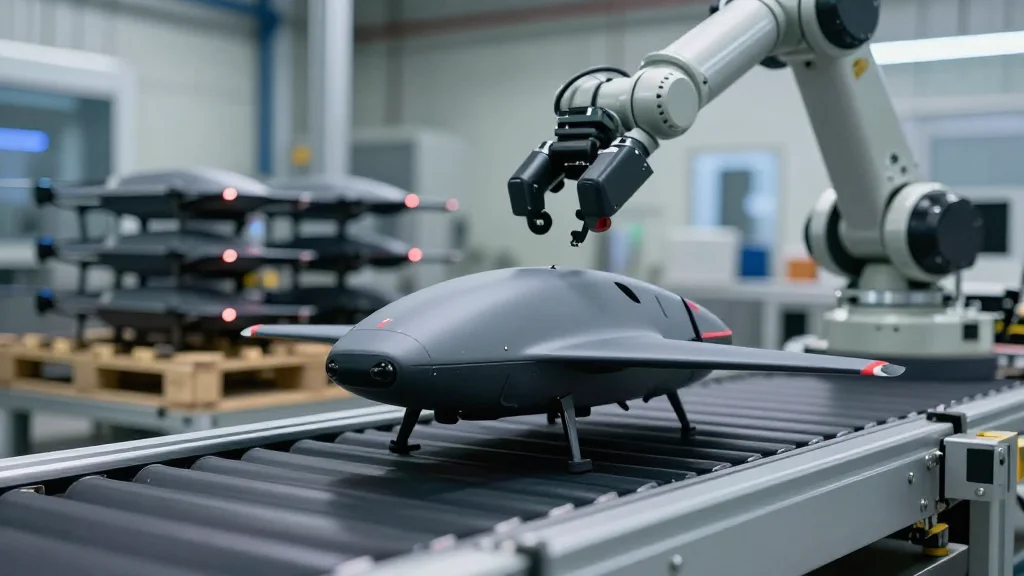
Wild Hornet’s STING Drone Hits 10,000‑Unit Monthly Production, Sparking Defense‑Manufacturing Surge

Why It Matters
The mass production of interceptor drones like the STING reshapes the economics of air‑defense, allowing nations to field large numbers of affordable systems against low‑cost attack drones. This democratization of defensive capability could alter strategic calculations in conflict zones where swarming tactics are prevalent. Furthermore, the rapid scaling of manufacturing capacity demonstrates how AI integration and modular design can accelerate the transition from prototype to serial production. The competitive landscape, featuring multiple firms delivering similar performance at comparable prices, is likely to drive further innovation and price reductions, pressuring traditional defense contractors to adapt or partner with emerging UAV specialists.
Key Takeaways
- •Wild Hornet’s STING drone reaches 10,000 units per month production capacity
- •STING priced between $1,000 and $2,500, with 280 km/h speed and 37 km range
- •WIY DRONES’ STRILA produces ~100 units daily, unit price $2,300
- •Octopus joint Ukraine‑UK production targets 1,000 units per month from Feb 2026
- •All platforms feature AI‑guided terminal phase targeting and thermal imaging
Pulse Analysis
The current wave of interceptor‑drone manufacturing reflects a broader pivot in defense procurement toward modular, software‑centric weapons. Historically, air‑defense has been dominated by large, radar‑guided missile systems that require extensive logistics and high unit costs. The emergence of quadcopter‑based interceptors compresses that model into a package that can be produced in automotive‑style assembly lines, leveraging economies of scale and reducing per‑unit cost dramatically.
From a market perspective, the entry of multiple firms—Wild Hornet, WIY DRONES, Fourth Law, and the Ukraine‑UK Octopus consortium—creates a competitive cluster that is likely to spur rapid iteration. Companies that can integrate more sophisticated AI for autonomous target discrimination will capture premium contracts, while those that focus on cost‑efficiency will dominate bulk sales to smaller states. The price elasticity observed, with the STING undercutting many legacy systems, suggests that future procurement budgets will allocate a larger share to numbers‑over‑capability strategies.
Looking ahead, supply‑chain resilience will become the decisive factor. The reliance on high‑trust motors, battery technology, and thermal sensors means that any disruption—whether geopolitical or raw‑material driven—could throttle output. Firms that diversify component sources or invest in in‑house production will maintain the aggressive output rates promised. In the next 12 months, we can expect to see the first large‑scale combat evaluations of these drones, and possibly the first export contracts to regions like the Middle East and Southeast Asia, where drone threats are already reshaping defense postures.
Wild Hornet’s STING Drone Hits 10,000‑Unit Monthly Production, Sparking Defense‑Manufacturing Surge
Comments
Want to join the conversation?
Loading comments...