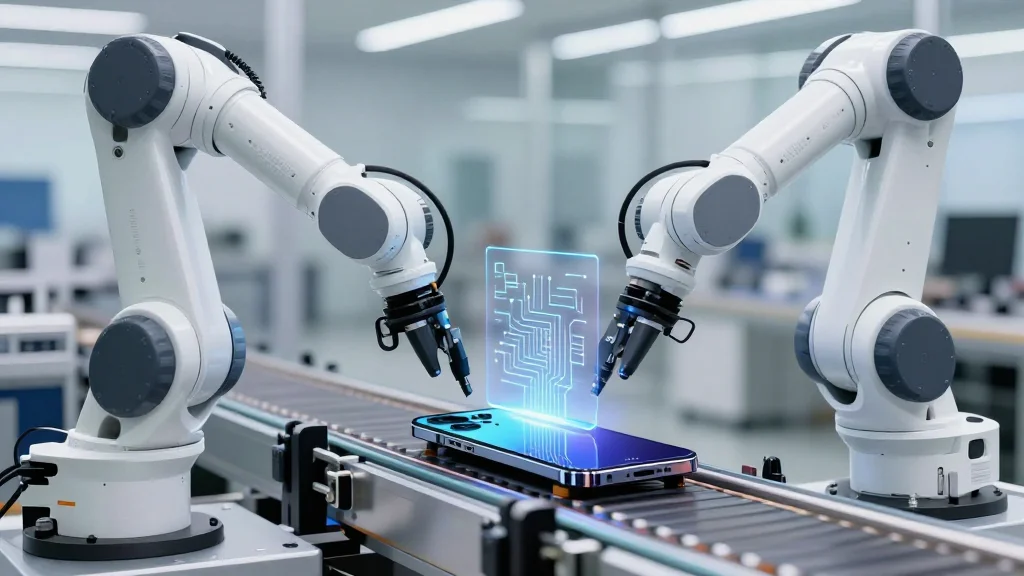
Xiaomi's $330 M Dark Factory Assembles a Smartphone Every 3.15 Seconds

Companies Mentioned
Why It Matters
The Changping dark factory demonstrates that ultra‑high‑speed, robot‑only assembly is feasible for complex consumer electronics, a domain previously dominated by labor‑intensive processes. By achieving a throughput of one phone every 3.15 seconds, Xiaomi sets a new benchmark for production efficiency, potentially reshaping cost structures and geographic strategies across the smartphone industry. Moreover, the heavy reliance on proprietary software and vision systems underscores the growing importance of AI in quality control, suggesting that future competitive advantage will hinge as much on data and algorithms as on hardware design. For suppliers and investors, the plant highlights a surge in demand for advanced robotics, machine‑vision components and industrial‑IoT platforms. Companies that can provide reliable, scalable automation solutions may see accelerated growth, while those lagging in AI‑driven manufacturing risk losing market share to firms that can deliver faster, cheaper, and higher‑quality devices.
Key Takeaways
- •Xiaomi's Changping plant cost about 2.4 billion yuan ($330 million) to build.
- •The factory runs at 81% automation and can produce a flagship phone every 3.15 seconds.
- •Annual capacity reaches roughly 10 million devices across 11 production lines.
- •Xiaomi developed 100% of the software and 96.8% of the packaging equipment in‑house.
- •More than 500 patents have been filed related to the dark‑factory technology.
Pulse Analysis
Xiaomi’s dark factory is less a one‑off showcase and more a strategic pivot toward capital‑intensive, technology‑driven manufacturing. Historically, smartphone OEMs have balanced labor costs against flexibility, locating factories in regions with cheap workforces. By investing $330 million in a near‑lights‑out plant, Xiaomi bets that the long‑term savings from reduced labor, higher yield, and faster time‑to‑market will outweigh the upfront capital outlay. This mirrors trends in the semiconductor sector, where firms like TSMC have justified multi‑billion‑dollar fabs by locking in capacity and quality advantages.
The broader market impact will likely be a bifurcation of manufacturers into two camps: those that can afford to build or lease highly automated lines, and those that remain dependent on traditional labor models. The former group can accelerate product cycles, respond to demand spikes, and protect margins against wage inflation. The latter may face pressure to either consolidate, outsource to third‑party automation providers, or risk losing market relevance. In the short term, suppliers of industrial robots, AI vision systems and edge‑computing hardware stand to benefit from increased orders, while software firms that can integrate these components into a seamless platform will become indispensable partners.
Looking ahead, the key risk for Xiaomi is the scalability of its proprietary platform. As the factory adds new phone models or expands capacity, the software must adapt without introducing bottlenecks. Any failure in the AI‑driven quality‑control loop could erode the very cost advantage the dark factory promises. Competitors will watch closely, and we may see a wave of joint ventures between OEMs and robotics specialists aimed at sharing development risk while replicating the efficiency gains Xiaomi has demonstrated.
Xiaomi's $330 M Dark Factory Assembles a Smartphone Every 3.15 Seconds
Comments
Want to join the conversation?
Loading comments...