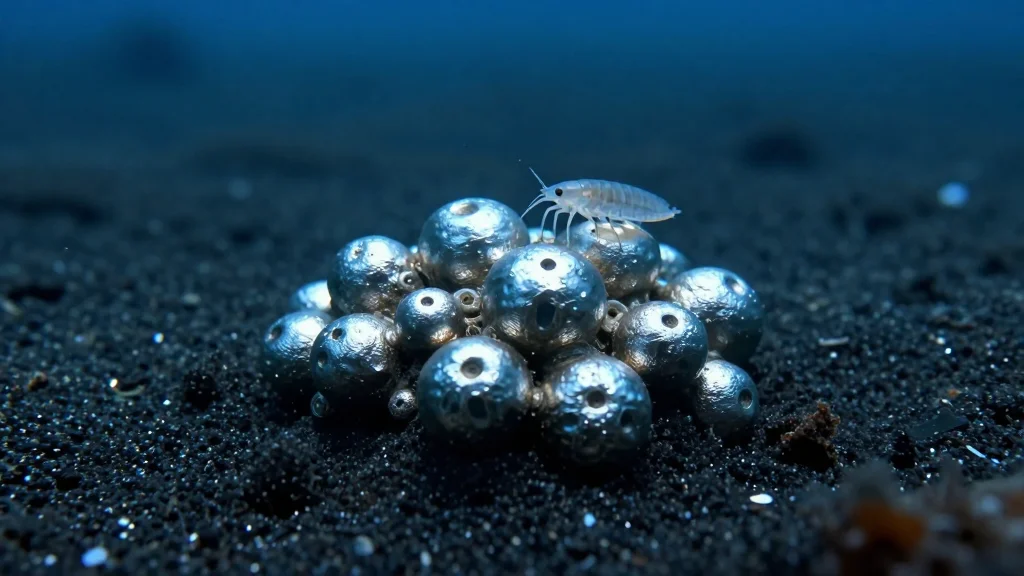
24 New Deep‑Sea Species Discovered in Pacific Abyss, Raising Stakes for Battery‑Metal Mining

Companies Mentioned
Why It Matters
The discovery of 24 new species in the CCZ highlights a critical knowledge gap that could influence global decisions on deep‑sea mining. As governments and corporations race to secure nickel, cobalt and copper for battery production, the ecological stakes are high; uncharted species may be lost before they are even documented. The findings also provide concrete data for policymakers debating the balance between climate‑friendly metal supply and marine conservation, potentially prompting stricter environmental safeguards or moratoria on seabed extraction. Furthermore, the timing aligns with The Metals Company’s ambitious 65,000‑km² mining application, making the scientific results a de‑facto reference point for impact assessments. If regulators incorporate biodiversity considerations into licensing, the industry could face higher compliance costs and longer timelines, reshaping investment strategies in the battery‑metal sector.
Key Takeaways
- •24 new amphipod species, including a new superfamily and family, described from the CCZ.
- •CCZ spans roughly 6 million km² and holds abundant nickel, cobalt and copper nodules.
- •Estimated 5,600 species in the CCZ, with about 90% still undescribed.
- •The Metals Company filed a consolidated mining application for ~65,000 km², twice Belgium’s size.
- •NOAA’s new rule allows simultaneous exploration and commercial permit applications, accelerating mining proposals.
Pulse Analysis
The convergence of taxonomy and mining in the Clarion‑Clipperton Zone marks a pivotal moment for both sectors. Historically, deep‑sea mining has been hampered by technical challenges and limited market demand. The surge in battery‑metal demand, driven by electric‑vehicle adoption and grid‑scale storage, has transformed the CCZ into a high‑value target. Yet, the scientific community’s rapid cataloguing of new species underscores a parallel urgency: the need to understand and protect an ecosystem that has been largely invisible to humanity.
From a market perspective, The Metals Company’s 65,000 km² application signals confidence that the regulatory environment will accommodate large‑scale extraction. However, the discovery of previously unknown fauna could trigger stricter environmental reviews under the International Seabed Authority’s framework, potentially slowing project timelines. Investors may need to factor in heightened ESG scrutiny and the possibility of operational delays.
Strategically, the CCZ could become a litmus test for how the mining industry balances resource security with biodiversity preservation. If policymakers integrate the new species data into licensing criteria, we may see a new tier of ‘biodiversity‑offset’ requirements, reshaping cost structures and prompting firms to invest in advanced environmental monitoring technologies. The outcome will likely influence future offshore mining ventures, setting precedents for how the global community navigates the trade‑off between green‑energy ambitions and oceanic stewardship.
24 New Deep‑Sea Species Discovered in Pacific Abyss, Raising Stakes for Battery‑Metal Mining
Comments
Want to join the conversation?
Loading comments...