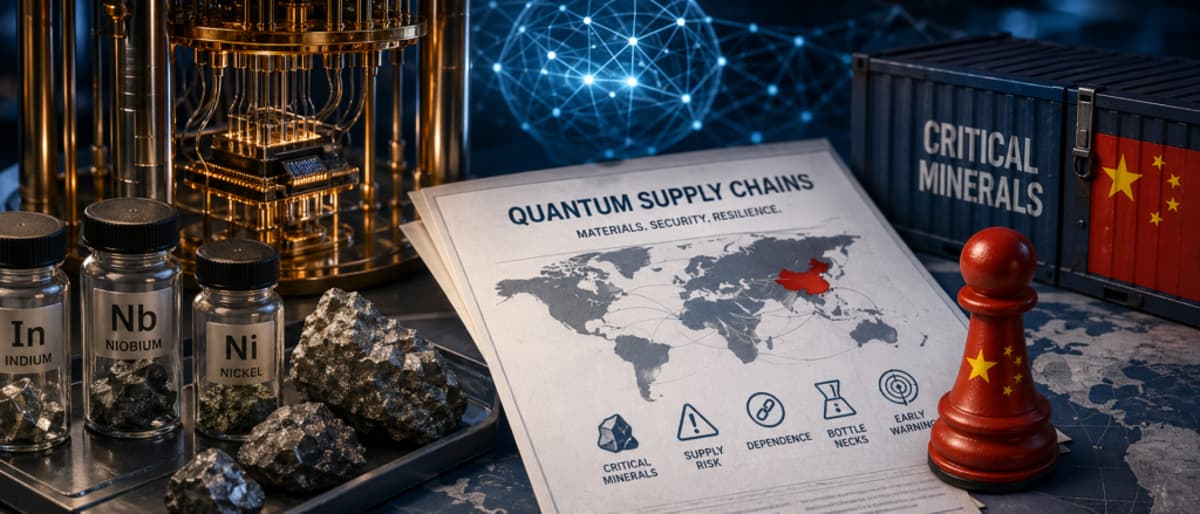
China’s Minerals Leverage Raises Quantum Security Concerns
Companies Mentioned
Why It Matters
Disruptions in niobium, nickel and other specialty minerals could stall quantum hardware development, threatening national security and the United States’ leadership in emerging quantum technologies.
Key Takeaways
- •US imports 100% of niobium; Chinese stakes in Brazilian producers.
- •China's influence over Indonesian nickel refining threatens quantum shielding supplies.
- •Quantum chips need indium, niobium, nickel alloys—tiny yet essential inputs.
- •Study proposes a dashboard to track mineral inventories and substitution options.
- •Export restrictions may drive Chinese substitution but leave cryogenic gaps.
Pulse Analysis
Quantum computing’s rapid progress masks a fragile dependency on a handful of specialty minerals. Elements such as indium, niobium and nickel‑iron alloys are required in minute quantities for superconducting qubits, Josephson junctions and magnetic shielding. While the overall volume is small, the materials are highly specialized and sourced from a narrow set of global producers. China’s strategic investments in Brazil’s niobium mines and Indonesia’s nickel refineries give it outsized influence over these critical inputs, creating a geopolitical lever that could be pulled at any moment.
The study’s proposed Quantum Criticality and Critical Minerals dashboard aims to fill a glaring intelligence gap. By aggregating inventory data, substitution pathways, qualification timelines and geopolitical signals, the tool would enable policymakers and quantum firms to anticipate supply constraints before they cascade into program‑level failures. Such foresight is crucial because qualifying alternative suppliers or redesigning components can take years, and temporary export curbs—already seen with bismuth, antimony and rare earths—can quickly ripple through the quantum supply chain.
For U.S. industry leaders, the findings underscore the urgency of diversifying sources and investing in domestic processing capabilities. While export controls may slow China’s access to certain equipment, they also incentivize Beijing to develop its own substitutes, especially in cryogenics and high‑purity materials. A coordinated response—combining strategic stockpiles, allied sourcing agreements and the proposed dashboard—will be essential to safeguard the quantum ecosystem and support the transition to post‑quantum cryptography.
China’s Minerals Leverage Raises Quantum Security Concerns
Comments
Want to join the conversation?
Loading comments...