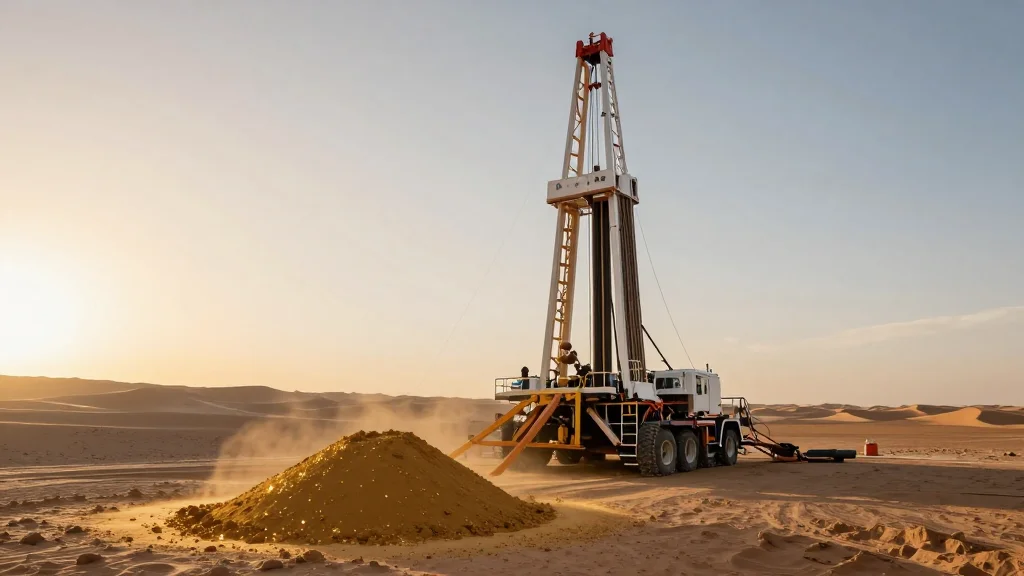
Desert Gold Initiates Phase One RC Drilling in Mali
Why It Matters
The drill campaign could significantly increase Desert Gold’s proven gold reserves, boosting its production profile and attracting financing. Expanding Mali’s gold pipeline also reinforces the country’s status as a key West African mining hub.
Key Takeaways
- •4,250 m RC drilling launched across five SMSZ targets.
- •GWN zone holds 92,600 oz indicated resource at 1.06 g/t Au.
- •Mogoyafara South resource estimated at 447,500 oz, open for expansion.
- •Barani Gap inferred resource of 30,200 oz under exploration.
- •Kolon‑Soa corridor spans 8 km, initial 790 m drilling planned.
Pulse Analysis
West Africa remains a powerhouse for gold production, and Mali ranks among the continent’s top exporters. Desert Gold Ventures’ Senegal‑Mali Shear Zone (SMSZ) project sits within the prolific Birimian belt, a geological formation that has delivered multiple multi‑million‑ounce discoveries over the past decade. By focusing on a 4,250‑metre reverse‑circulation drill campaign, the company is positioning itself to capitalize on the region’s untapped potential while reinforcing Mali’s reputation as a stable mining jurisdiction. The project also benefits from recent infrastructure upgrades, including road improvements that lower logistics costs.
The first‑phase program targets five priority zones: Koussili, GWN, Mogoyafara South, Barani Gap and Kolon‑Soa. GWN already hosts an indicated 2.72 million‑ton resource grading 1.06 g/t Au, equivalent to roughly 92,600 ounces, while Mogoyafara South carries an inferred 447,500‑ounce resource that remains open‑ended. Barani Gap adds another 30,200 ounces of inferred material, and the 8‑km Kolon‑Soa corridor is being tested for near‑surface oxide mineralisation. By drilling both down‑plunge and strike extensions, Desert Gold aims to convert inferred ounces into higher‑confidence categories and uncover new high‑grade shoots.
Successful expansion of the SMSZ resource could lift Desert Gold’s 2026 production outlook and attract additional equity financing, given the current premium on high‑grade West African gold assets. Investors will watch the drill results for any indication of ore‑grade jumps that could justify a near‑term mine development, especially at the proposed Barani East oxide mine. Moreover, the program underscores Mali’s continued commitment to mining‑friendly policies, which may encourage other junior explorers to allocate capital to the region, reinforcing its role in the global gold supply chain.
Desert Gold initiates phase one RC drilling in Mali
Comments
Want to join the conversation?
Loading comments...