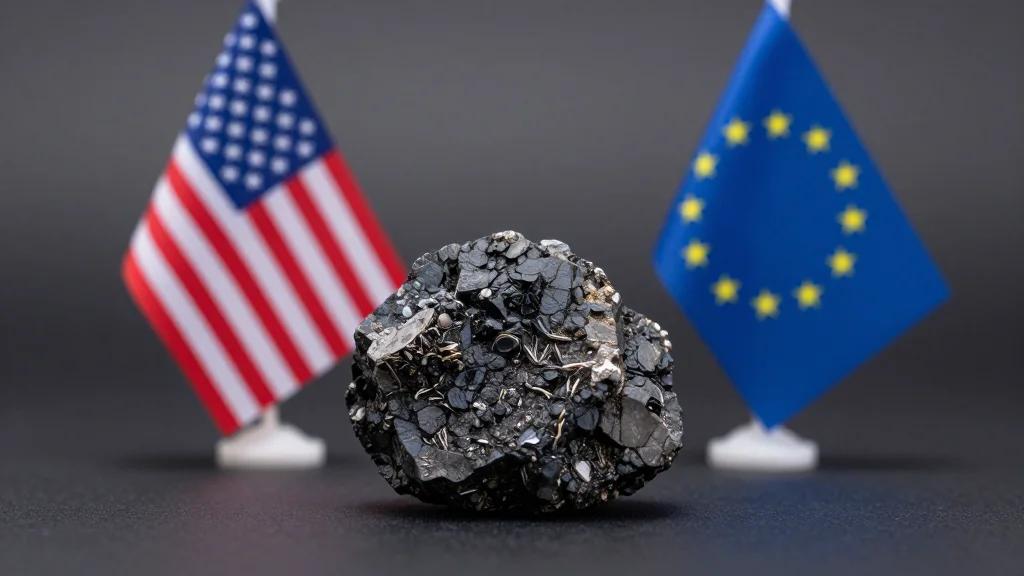
EU and US Sign MoU to Coordinate Critical Minerals Supply Chains

Why It Matters
The agreement directly confronts the structural imbalance where raw ore is globally dispersed but high‑value processing is concentrated in a few non‑allied nations. By creating a coordinated policy and investment framework, the EU and U.S. aim to secure supply for sectors that are essential to national security and climate goals, from semiconductor chips to electric‑vehicle batteries. Reducing dependence on a single supplier reduces geopolitical risk and stabilises prices, which in turn can accelerate the rollout of clean‑energy technologies. Furthermore, the MoU signals to other allies—such as Canada, South Korea and the United Kingdom—that a unified Western front on critical minerals is forming. This could catalyse a broader coalition, encouraging joint ventures, technology sharing and standard‑setting that collectively diminish the leverage of any single non‑aligned producer.
Key Takeaways
- •April 24 2026: MoU signed by U.S. Secretary of State Marco Rubio and EU Trade Commissioner Maroš Šefčovič.
- •Framework covers exploration, mining, refining, recycling and trade policy coordination.
- •Introduces border‑adjusted price floors and joint standards to protect domestic industries.
- •Links EU to existing $8.5 billion U.S.–Australia critical‑minerals framework and U.S.–Japan action plan.
- •Targets the 86 % processing concentration in three countries, aiming to shift capacity to allied economies.
Pulse Analysis
The EU‑US memorandum arrives at a moment when demand for copper, lithium, nickel, cobalt and rare‑earth elements is soaring, driven by AI hardware, electric‑vehicle production and renewable‑energy infrastructure. Historically, Western attempts to diversify supply have focused on mining licences in Africa and the Americas, but have stumbled at the processing stage where China’s dominance remains entrenched. By explicitly targeting downstream refining and recycling, the MoU addresses the “processing bottleneck” that has limited previous diversification efforts.
From a market perspective, the coordinated price‑floor mechanism could introduce a new benchmark for critical‑minerals pricing, potentially dampening price volatility that has plagued the sector since 2022. If the EU and U.S. can align subsidies and tax incentives, they may attract private capital to build domestic refineries that would otherwise be uneconomic in a fragmented market. This could reshape global trade flows, pulling a share of the current 86 % processing volume into allied hands and weakening China’s leverage.
Looking ahead, the pact’s success hinges on execution speed and the ability to marshal financing—both public and private—at scale. The $8.5 billion Australia framework demonstrates that sizable funding can be mobilised when political will is strong. However, the EU‑US partnership must also navigate regulatory differences, environmental standards and community opposition to new mining and processing projects. If these hurdles are overcome, the MoU could become the cornerstone of a resilient, Western‑led critical‑minerals ecosystem that underpins the next wave of clean‑energy and digital technologies.
EU and US Sign MoU to Coordinate Critical Minerals Supply Chains
Comments
Want to join the conversation?
Loading comments...