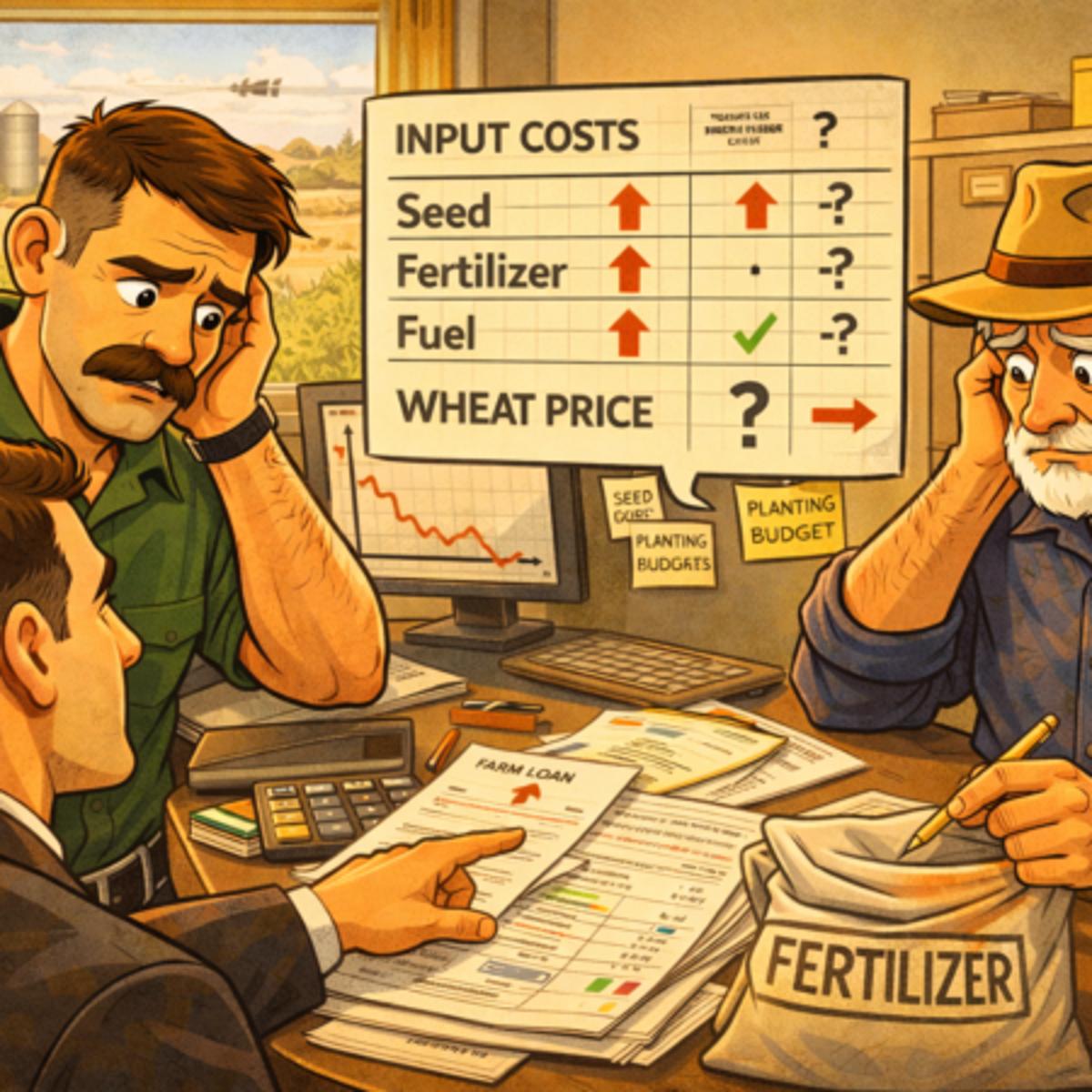
High Input Costs Don’t Guarantee High Grain Prices
Key Takeaways
- •Wheat price moves average $42/t between seeding and harvest.
- •Harvest price higher than seeding in 20 of 36 seasons.
- •Spike seeding years see average $70/t price decline.
- •Input costs lock early while price risk remains high.
- •Risk premium often unwinds as season information improves.
Pulse Analysis
The long‑term data set reveals that wheat price dynamics are driven more by global supply‑demand shifts than by the timing of a farmer’s planting decision. Seasonal fluctuations of roughly $42 per tonne reflect changing expectations around weather, geopolitical events, and inventory levels, which can reverse the early‑season risk premium. By decoupling seeding and harvest price expectations, the study challenges the conventional wisdom that a strong planting price guarantees a profitable exit.
When early‑season prices surge, they often embed a shock‑driven premium—think sudden fertilizer cost spikes, energy price hikes, or geopolitical tensions. As the growing season progresses and crop forecasts firm up, that premium can erode, leading to the observed $70‑per‑tonne declines in spike years. For growers, this creates a timing mismatch: most production inputs are purchased at planting, yet the revenue side remains highly uncertain, amplifying margin pressure.
The practical takeaway for agribusinesses is to embed flexible risk‑management tools into planting plans. Forward contracts, price collars, and diversified marketing channels can mitigate the downside of price reversals. Advisors should also incorporate scenario analysis that accounts for both input cost trajectories and potential price unwind. Policymakers and industry groups might consider supporting market information platforms that reduce information asymmetry, helping growers make more informed decisions in an inherently volatile commodity market.
High Input Costs Don’t Guarantee High Grain Prices
Comments
Want to join the conversation?