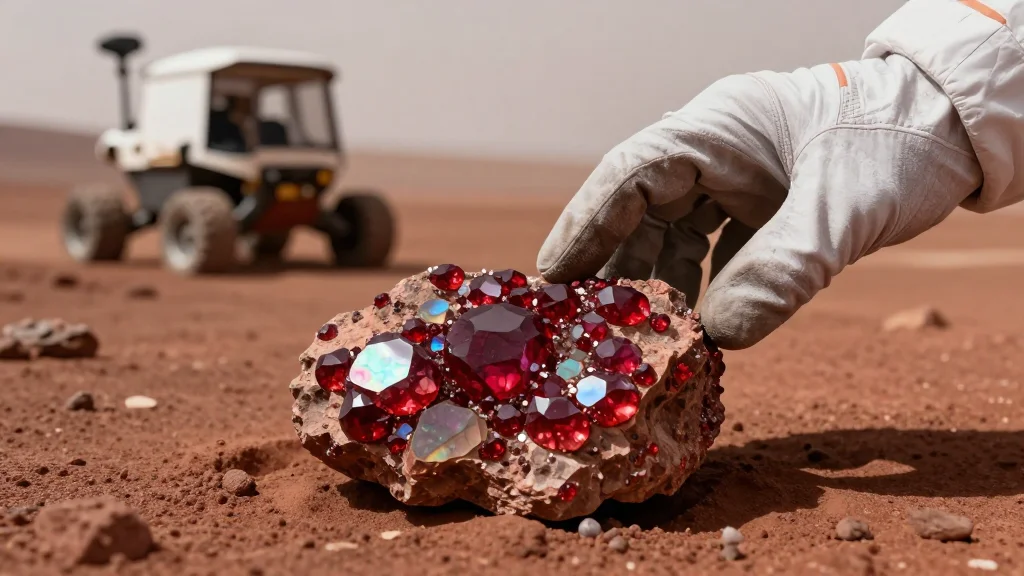
Mars Holds Trace Rubies and Opals, but Mining Them Remains Impractical

Companies Mentioned
Why It Matters
The identification of gemstone‑like minerals on Mars reshapes how the mining industry views extraterrestrial resources. It underscores that not all mineral deposits are economically viable, prompting investors and policymakers to focus on bulk commodities—water, regolith, and metals—rather than high‑value niche materials. Moreover, the scientific payoff from studying these minerals could outweigh any commercial return, offering clues about impact history and potential biosignatures that inform future exploration strategies. For the broader mining sector, the findings serve as a cautionary tale: the allure of exotic resources must be balanced against realistic extraction costs and market demand. As private space firms mature, the line between scientific curiosity and commercial exploitation will become sharper, influencing regulatory frameworks and investment decisions across both terrestrial and off‑world mining enterprises.
Key Takeaways
- •Perseverance’s spectrometer detected corundum (ruby/sapphire) and hydrated silica (opal) in Jezero Crater rocks.
- •Mineral grains are sub‑millimeter, formed by rapid asteroid impacts rather than slow Earth‑like processes.
- •Candice Bedford (Purdue) and Vivian Sun (JPL) say the stones are not gem‑quality and are too small for commercial use.
- •Matt Gialich (AstroForge) notes Earth‑based rubies and opals make Martian mining economically unjustifiable.
- •Scientific value lies in using these minerals to trace Mars’s impact history and search for preserved biosignatures.
Pulse Analysis
The excitement around Martian gemstones is less about future jewelry markets and more about what the minerals reveal about planetary evolution. Impact‑generated corundum signals that Mars experienced high‑energy collisions capable of melting and fusing surface materials, a process that can reset the geological clock and obscure earlier histories. By contrast, hydrated silica’s ability to encapsulate organic molecules makes it a prime candidate for detecting ancient microbial life, a goal that has driven much of Mars exploration funding.
From an industry perspective, the episode highlights a recurring pattern: early hype followed by sober assessment of economic realities. The $30‑billion lunar outpost plan illustrates how governments are willing to pour capital into infrastructure that supports long‑term resource utilization, yet they remain cautious about speculative high‑value commodities. Private firms will likely adopt a similar playbook—first secure water and construction materials to enable habitats, then consider secondary resources if extraction costs drop.
Looking forward, the decisive factor will be technology. Advances in autonomous in‑situ resource processing, such as electro‑chemical extraction of metals or 3D‑printing using regolith, could shift the cost curve dramatically. If those breakthroughs materialize, the same impact‑formed minerals that are now scientific curiosities could become feedstock for manufacturing, turning a perceived liability into an asset. Until then, the mining narrative on Mars stays firmly in the realm of research, with commercial ambitions focused on more abundant, bulk resources.
Mars Holds Trace Rubies and Opals, but Mining Them Remains Impractical
Comments
Want to join the conversation?
Loading comments...