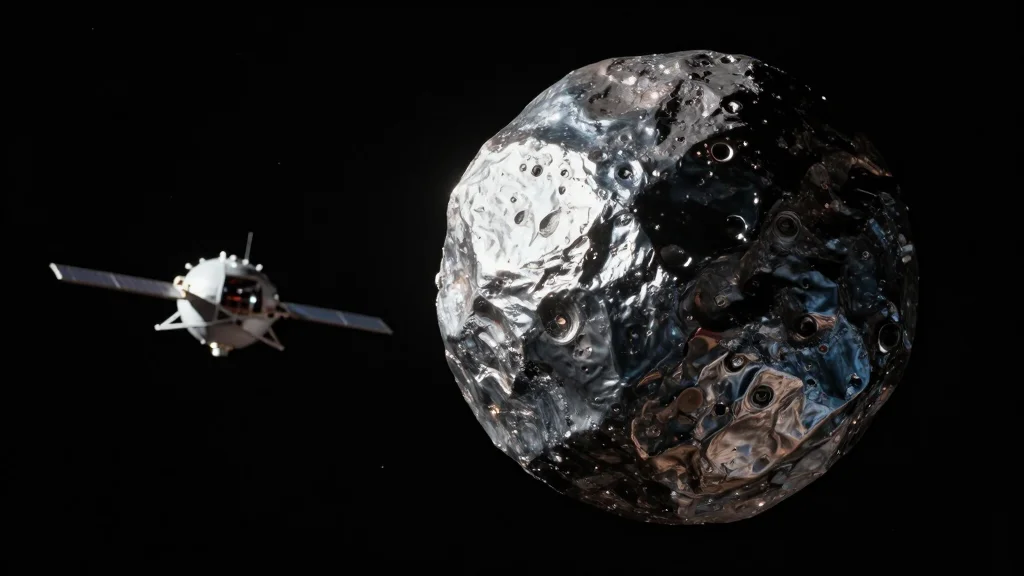
NASA's Psyche Flyby Accelerates Trek to Metal‑Rich Asteroid, Reviving Space Mining Talk

Companies Mentioned

NASA
Why It Matters
The Psyche mission bridges planetary science and the nascent field of space mining, providing the first empirical data on a metallic asteroid that could, in theory, supply raw materials far beyond Earth’s finite reserves. If future technologies can overcome the immense engineering and cost barriers, asteroid mining could reshape global supply chains for critical minerals, reducing reliance on terrestrial mines that are often geopolitically sensitive or environmentally contentious. Moreover, the mission’s high‑profile visibility draws private‑sector interest and may accelerate investment in related technologies—advanced robotics, in‑situ resource utilization, and deep‑space propulsion. Even without immediate commercial extraction, the data will inform policy discussions about property rights, international regulations, and the economic feasibility of harvesting off‑world resources.
Key Takeaways
- •Psyche spacecraft flew within 2,864 miles of Mars on May 15, gaining ~1,000 mph.
- •The gravity assist shifted Psyche’s orbital plane by about 1 degree.
- •NASA confirms on‑track arrival at asteroid 16 Psyche in August 2029.
- •16 Psyche is estimated to contain metals worth many quadrillions of dollars.
- •Jim Bell, ASU planetary scientist, highlighted the mission’s calibration imaging.
Pulse Analysis
Psyche’s Mars flyby is more than a navigational checkpoint; it is a proof‑of‑concept for the kind of multi‑planet choreography required for future resource extraction missions. Historically, mining has been driven by the economics of proximity and extraction cost. By demonstrating that a spacecraft can leverage planetary gravity to shave weeks off a multi‑year journey, NASA is effectively lowering the logistical barrier that has kept asteroid mining in the realm of theory.
The market reaction to Psyche’s progress underscores a growing convergence between space exploration and commodity finance. While the asteroid’s metal wealth is quantified in quadrillions, the capital intensity of building, launching, and operating a mining fleet in deep space remains astronomical. Investors are therefore watching Psyche’s scientific payloads for clues about ore grade, metal distribution, and structural integrity—data that could de‑risk future private ventures. In the short term, the mission may boost equities tied to nickel and copper, as analysts hedge against a potential future supply influx.
Looking forward, the key to turning Psyche’s scientific success into a mining reality lies in three areas: (1) developing autonomous extraction and processing hardware that can operate in micro‑gravity; (2) establishing a legal framework that clarifies ownership and profit rights for extraterrestrial resources; and (3) creating a viable economic model that justifies the multi‑billion‑dollar upfront investment. Psyche’s August 2029 orbit will be the first data point in that long‑term equation, and the industry’s response will likely dictate whether space mining remains a speculative headline or evolves into a new frontier of resource economics.
NASA's Psyche Flyby Accelerates Trek to Metal‑Rich Asteroid, Reviving Space Mining Talk
Comments
Want to join the conversation?
Loading comments...