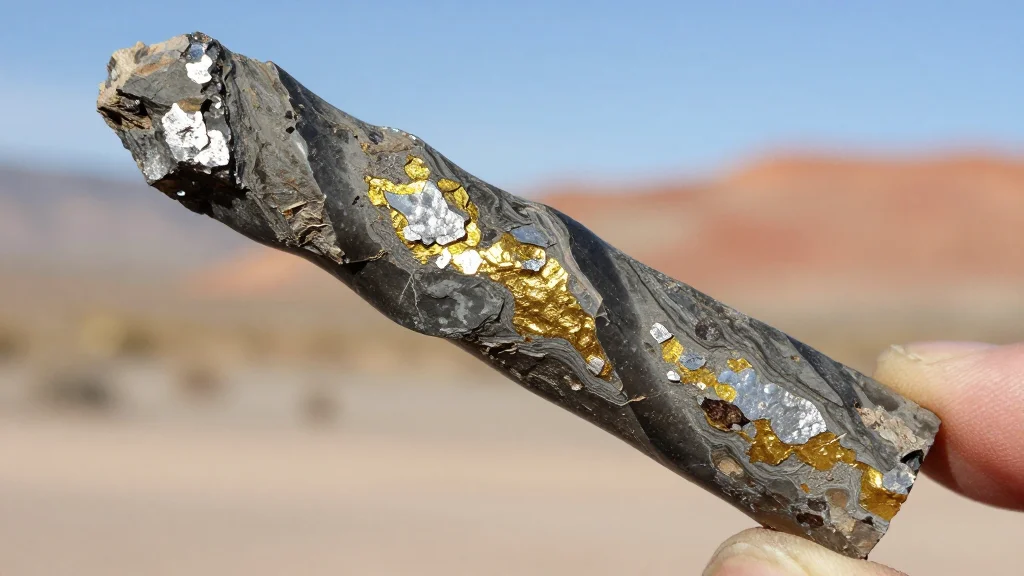
NevGold's Nevada Antimony Drill Hits All 17 Holes, Boosting U.S. Critical Mineral Push

Companies Mentioned
Why It Matters
Antimony’s strategic applications in defense and high‑tech sectors make its supply security a national priority. By demonstrating a viable domestic source, NevGold helps diversify the supply chain away from China, mitigating geopolitical risk. The project also illustrates how brownfield assets can be repurposed for critical minerals, potentially accelerating timelines compared to greenfield developments. If NevGold can bring production online within the next few years, it would provide a domestic feedstock for ammunition manufacturers, battery producers and semiconductor fabs, supporting U.S. industrial competitiveness and national security. The project’s progress will likely influence future policy decisions, funding allocations, and the pace at which other critical‑mineral projects move from exploration to operation.
Key Takeaways
- •All 17 drillholes at Nevada's Limousine Butte returned oxide antimony (0.27‑0.32% Sb) and gold (0.34‑0.41 g/t Au) grades.
- •Antimony is classified as a top‑priority U.S. critical mineral for defense and high‑tech applications.
- •U.S. government has deployed Section 232, the Defense Production Act and fast‑track permitting to accelerate domestic projects.
- •NevGold’s share price rose modestly after the drill‑hole announcement, reflecting investor confidence in a rare U.S. antimony source.
- •Next steps include Phase II drilling and a feasibility study slated for Q4 2026.
Pulse Analysis
NevGold’s uniform drill success is a rare data point in a sector where many projects still struggle to prove consistent mineralization. The antimony market has long been dominated by a handful of overseas producers, and the U.S. has historically relied on imports for defense‑grade material. By unlocking a brownfield resource that has sat idle for three decades, NevGold demonstrates a pragmatic pathway: repurpose legacy mining infrastructure to meet modern strategic needs. This approach reduces upfront capital outlays and shortens the permitting timeline, both of which are critical under the current policy environment that rewards speed.
From a financial perspective, the antimony price premium tied to supply security could lift the project's economics above what pure commodity pricing would suggest. Investors are already pricing in a strategic premium for domestic critical‑mineral assets, as seen in the recent rally of peers. However, the market remains cautious; processing antimony alongside gold adds technical complexity, and the company must secure financing for a processing plant that meets stringent environmental standards.
Looking forward, NevGold’s progress will serve as a bellwether for the broader U.S. critical‑mineral agenda. If the feasibility study confirms a low‑cost, environmentally compliant production model, the Department of Defense may consider long‑term off‑take agreements, further de‑risking the project. Conversely, any delay or cost overrun could reinforce skepticism about the viability of domestic antimony supply. In either case, the Limousine Butte drill results have already shifted the conversation from policy intent to tangible on‑the‑ground outcomes, setting a benchmark for future domestic mining initiatives.
NevGold's Nevada Antimony Drill Hits All 17 Holes, Boosting U.S. Critical Mineral Push
Comments
Want to join the conversation?
Loading comments...