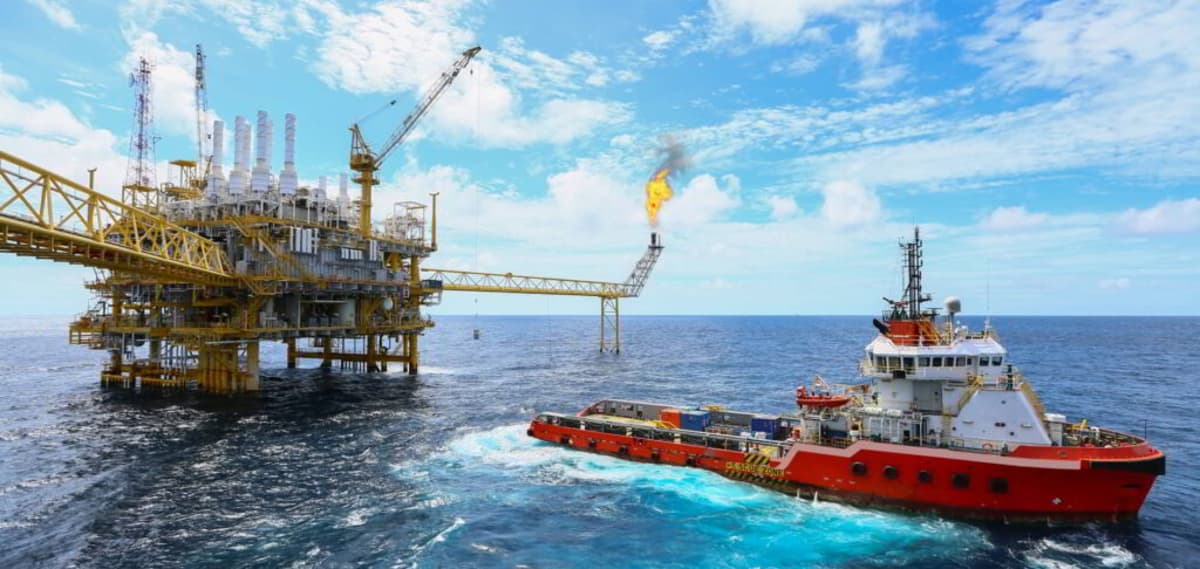
Oil & Gas Firms Step up Exploration Game to Tackle Supply Shortfall by 2050
Companies Mentioned
Why It Matters
The intensified focus on ultra‑deepwater projects is essential to bridge the looming oil supply deficit and safeguard energy security, directly influencing global markets and investor confidence. Successful frontier finds could unlock billions of dollars in value and reshape the upstream industry's risk‑reward calculus.
Key Takeaways
- •Oil majors target ultra‑deepwater to close 300‑billion‑barrel gap
- •Exploration created $120 billion value 2021‑2025 at $85 Brent
- •BP holds 100% of Brazil's Bumerangue discovery, valued $5.7 billion
- •Industry spend steadied at $16 billion in 2025 despite higher rig rates
Pulse Analysis
The 2050 oil supply outlook has sharpened the strategic lens of the world’s biggest exploration and production firms. Wood Mackenzie’s latest analysis shows that existing on‑stream fields will only deliver roughly 700 billion barrels of the near‑trillion‑barrel demand, leaving a 300‑billion‑barrel gap. To address this, companies are shifting capital toward ultra‑deepwater basins—areas beyond 1,500 meters—where recent super‑giant discoveries have demonstrated that high‑risk drilling can yield outsized returns. This pivot reflects a broader industry consensus that conventional onshore growth is insufficient for long‑term energy security.
Economic incentives are driving the deepwater surge. Between 2021 and 2025, exploration generated $120 billion in net value at $85 per barrel Brent, and still $54 billion at a more modest $65 Brent price point. Projects like BP’s $5.7 billion Bumerangue field in Brazil illustrate how a single successful well can lift annual industry value creation beyond $10 billion. Despite a temporary dip to $16 billion in 2025, spending remains resilient, buoyed by joint‑venture capital from non‑operating partners such as QatarEnergy. The near‑doubling of rig‑day rates has not deterred investment, underscoring confidence in the economics of frontier assets when oil prices stay above $65 per barrel.
For investors and policymakers, the deepwater renaissance signals both opportunity and risk. Companies with proven ultra‑deepwater expertise—ExxonMobil, Eni, BP, and Turkey’s TPAO—are securing majority stakes to lock in low‑cost, high‑margin resources, potentially reshaping global supply dynamics. Successful discoveries could mitigate the projected 40% output decline and reduce reliance on higher‑cost alternatives, stabilizing price volatility. However, the high capital intensity and technical challenges mean that a string of dry wells could quickly erode returns. Stakeholders must therefore monitor drilling outcomes, partnership structures, and regulatory environments as the industry navigates this pivotal expansion phase.
Oil & gas firms step up exploration game to tackle supply shortfall by 2050
Comments
Want to join the conversation?
Loading comments...