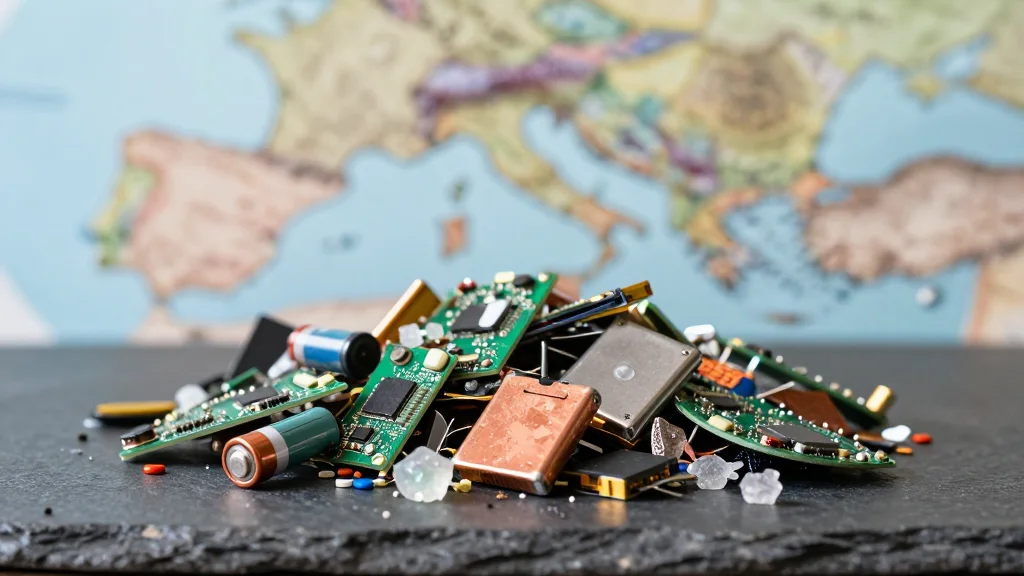
Recycling Could Meet Half of Europe’s Critical Mineral Needs by 2050
Why It Matters
Meeting half of Europe’s critical mineral needs through recycling would dramatically cut dependence on China, lower supply‑chain risk, and reduce environmental impacts of new mining, accelerating the continent’s clean‑energy goals.
Key Takeaways
- •Europe could source 56% of critical minerals from recycling by 2050.
- •Current waste contains ~2 Mt of critical minerals, projected 6 Mt by 2050.
- •China dominates 80% of global recycling capacity, limiting EU independence.
- •Full circularity needs unified market, investment in recycling infrastructure, skills.
- •Scaling recycling could cut new mining by up to 40% by 2050.
Pulse Analysis
Europe’s clean‑energy ambitions hinge on a steady supply of critical minerals such as lithium, cobalt and rare‑earth elements. Historically, the continent has depended on imports, especially from China, which dominates 19 of the 20 minerals identified by the International Energy Agency. By turning to “urban mines” – the billions of tonnes of waste generated by batteries, electric vehicles, and electronics – the EU can create a domestic source that buffers geopolitical risk and curtails the carbon footprint of primary extraction.
The FutuRaM study models three pathways for 2050: business‑as‑usual, improved recovery, and full circularity. In 2022, waste streams already held roughly 2 million metric tons of critical minerals, a figure projected to triple by mid‑century. If the secondary raw materials already collected are fully processed, they could satisfy 56 % of Europe’s demand. Realising this potential requires harmonised legislation, a pan‑European market for secondary materials, and substantial investment in recycling plants, data systems, and workforce training.
For industry leaders, the report signals a strategic imperative: invest now in recycling technologies and supply‑chain transparency to lock in future material security. Policymakers must align standards and incentives to accelerate plant construction and foster innovation in hydrometallurgical and mechanical recovery methods. By scaling recycling, the EU could slash new mining activity by up to 40 %, preserving ecosystems and reinforcing its position as a leader in the global energy transition.
Recycling could meet half of Europe’s critical mineral needs by 2050
Comments
Want to join the conversation?
Loading comments...