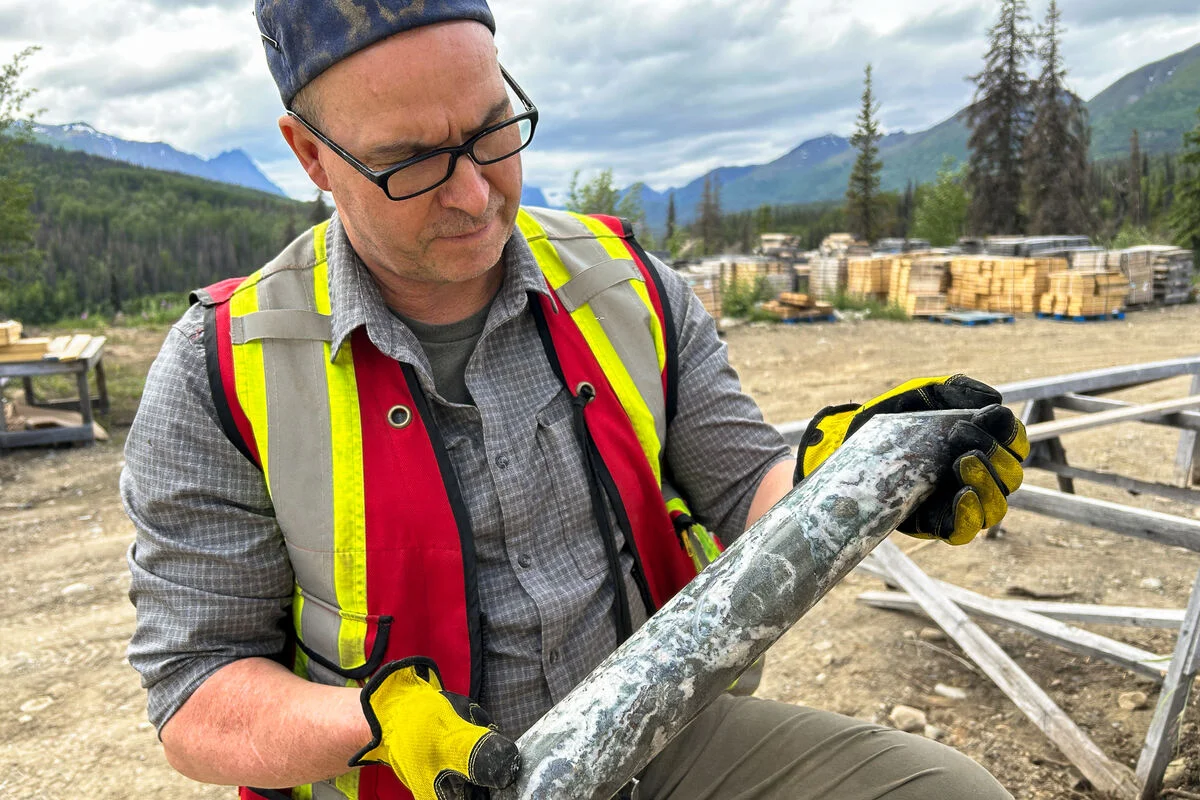
U.S. GoldMining Preps for Whistler Drilling
Why It Matters
The drill program could significantly expand the resource base, boosting the project's economics and making it a more attractive investment in a volatile commodities market. Successful discoveries would de‑risk the project and support financing or partnership opportunities.
Key Takeaways
- •Diamond‑drill program targets Whistler and Raintree extensions.
- •PEA projects $2.04 bn NPV at base‑case metal prices.
- •IRR reaches 33% with 2.1‑year payback under base case.
- •High‑grade copper‑gold anomalies identified near Mammoth and Snow Ridge.
- •Exploration aims to extend resource beyond 294 Mt indicated base.
Pulse Analysis
U.S. GoldMining Inc. is gearing up for a 2026 diamond‑drill campaign at its Whistler copper‑gold‑silver project, located roughly 100 miles northwest of Anchorage. The preliminary economic assessment released earlier this year outlined a 14.6‑year open‑pit operation capable of delivering 2.6 million ounces of gold at an all‑in sustaining cost of $1,046 per ounce, after accounting for substantial silver and copper co‑product credits. With an indicated resource of 294.5 million metric tons averaging 0.41 g/t gold, the project positions Alaska as a growing hub for North American base‑metal and precious‑metal mining.
The PEA’s financial outlook is compelling: at base‑case metal prices of $3,200 per ounce of gold, $37.50 per ounce of silver and $4.50 per pound of copper, the after‑tax net present value (5 % discount) stands at $2.04 billion, delivering a 33 % internal rate of return and a 2.1‑year payback. Sensitivity analysis shows that a modest rise to $5,000/oz gold, $70/oz silver and $5.85/lb copper more than doubles NPV to $4.88 billion and pushes IRR above 60 %. These metrics compare favorably with peer projects in the Pacific Northwest, suggesting strong cash‑flow potential even under volatile commodity markets.
The upcoming drill program focuses on four priority targets—Whistler Extension, Raintree Extension, the Mammoth‑Snow Ridge corridor, and the Hotfoot anomaly—each identified by recent soil and bedrock geochemistry that hints at undiscovered high‑grade zones. By establishing a pipeline of step‑out discoveries, U.S. GoldMining aims to expand both indicated and inferred resources, thereby extending mine life and enhancing project economics. Successful results could also lower financing costs and attract strategic partners, as investors increasingly favor assets with clear de‑risking pathways. The company expects initial drill results later in 2026, setting the stage for a potential 2027 pre‑FEA update.
U.S. GoldMining preps for Whistler drilling
Comments
Want to join the conversation?
Loading comments...