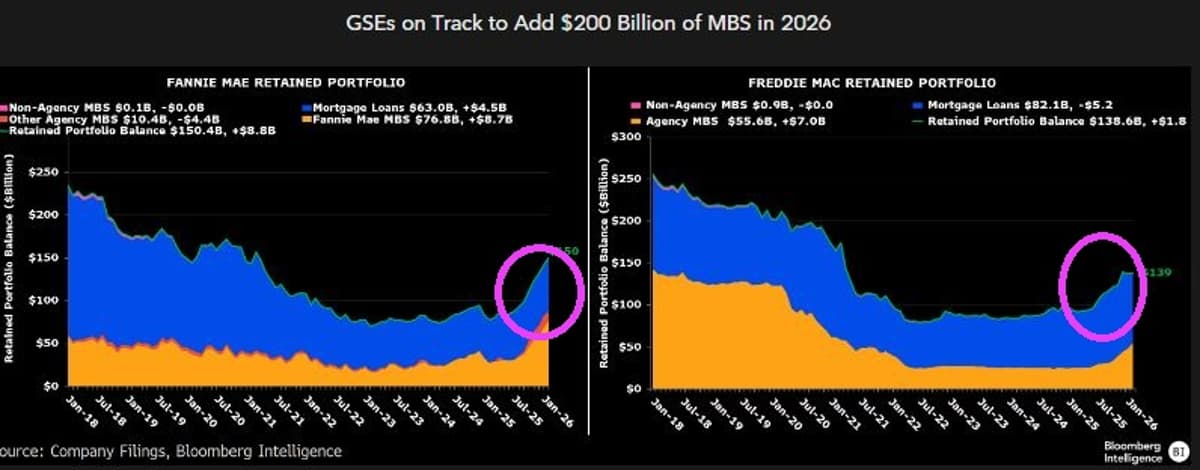
What Happened To The “Shut Down Fannie And Freddie” Movement? (Both Fannie And Freddie Are GROWING Their Retained Portfolios)
Key Takeaways
- •Retained portfolios of Fannie and Freddie are now expanding
- •Privatization hopes faded after 2022 GOP‑controlled Congress
- •Regulator Bill Pulte is steering GSEs toward larger balances
- •Growing balances raise taxpayer exposure to mortgage credit risk
- •March 2026 home sales hit weakest level since 2009
Pulse Analysis
The government‑sponsored enterprises Fannie Mae and Freddie Mac have long held “retained portfolios” – pools of mortgage loans they keep on their balance sheets rather than securitizing. Historically, these balances have trended downward as the agencies off‑loaded risk and moved toward a market‑based model. However, the latest data through January 2026 show a sharp reversal: both GSEs are adding billions of dollars to their holdings, a trend that began in late 2025. This shift signals a departure from the risk‑reduction path that reform advocates have championed for years.
The reversal coincides with a stalled political agenda. After Donald Trump’s 2024 re‑election and a Republican‑controlled House, many expected a rapid privatization of the GSEs, including a proposal to shrink retained portfolios to zero. Legislative inertia, coupled with the appointment of Bill Pulte as regulator, has instead produced a policy environment that encourages balance‑sheet growth. Pulte’s office argues that larger portfolios provide liquidity to the mortgage market, but critics contend that the move entrenches government exposure and delays the long‑sought exit strategy.
The expanding portfolios carry tangible market implications. Higher GSE holdings increase the federal government’s stake in mortgage credit risk, potentially amplifying taxpayer liability if housing prices falter. At the same time, the housing market is showing stress; March 2026 existing‑home sales were the weakest since the 2009 financial crisis. Policymakers now face a trade‑off between stabilizing mortgage supply and limiting fiscal risk. Future reforms will likely hinge on whether Congress can revive the “shut down Fannie and Freddie” movement or accept a larger, albeit more regulated, government role in housing finance.
What Happened To The “Shut Down Fannie And Freddie” Movement? (Both Fannie And Freddie Are GROWING Their Retained Portfolios)
Comments
Want to join the conversation?