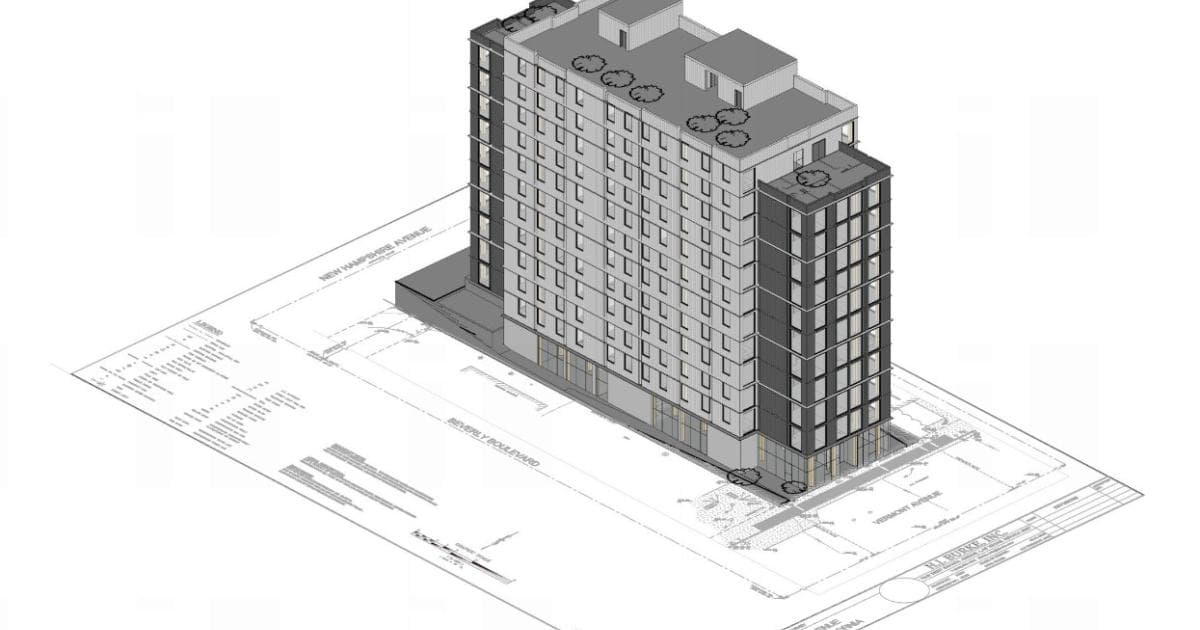
12-Story Affordable Housing Development Prposed at 315 N. Vermont Ave.
Why It Matters
The project adds much‑needed affordable units in a transit‑rich corridor, supporting LA’s housing goals and reducing reliance on cars.
Key Takeaways
- •113 affordable units across studios, two‑ and three‑bedrooms
- •12‑story building rises ~130 ft, includes rooftop amenity deck
- •Ground‑floor offers 3,496 sq ft of commercial space, no parking
- •Uses AB 2011 to convert commercial lot into residential housing
Pulse Analysis
Los Angeles continues to grapple with a chronic shortage of affordable housing, a problem amplified by rising rents and limited land supply. City planners have increasingly turned to transit‑oriented development as a lever to increase density without expanding sprawl. State legislation AB 2011, enacted in 2022, empowers developers to repurpose underutilized commercial parcels for residential use, streamlining approvals and encouraging mixed‑use projects near metro stations. The policy shift aligns with the city’s goal of delivering 150,000 new affordable units by 2035, making each conversion a critical piece of the puzzle.
The Goody Square proposal at 315 N. Vermont Avenue exemplifies that strategy. Designed by Lever Architecture with landscape work by Relm, the 12‑story tower will host 113 studio, two‑ and three‑bedroom units priced for households earning up to 80 percent of area median income. A modest 3,496 sq ft of ground‑level retail is slated to activate the street front, while a rooftop amenity deck offers residents outdoor space without requiring on‑site parking. Its proximity—just north of the Vermont/Beverly Metro stop—means tenants can rely on public transit for daily commutes, reducing car dependency.
Holos Communities, the developer behind the project, has built a reputation for leveraging AB 2011 to deliver affordable units in high‑need neighborhoods. By converting a $4 million vacant lot that previously stalled at 60 units, the firm adds roughly double the housing capacity while preserving commercial activity. The approach signals to investors that affordable, transit‑adjacent projects can be financially viable, especially when paired with streamlined entitlement processes. As more cities adopt similar zoning flexibilities, developers may replicate this model, potentially reshaping the supply chain for low‑income housing across the region.
12-story affordable housing development prposed at 315 N. Vermont Ave.
Comments
Want to join the conversation?
Loading comments...