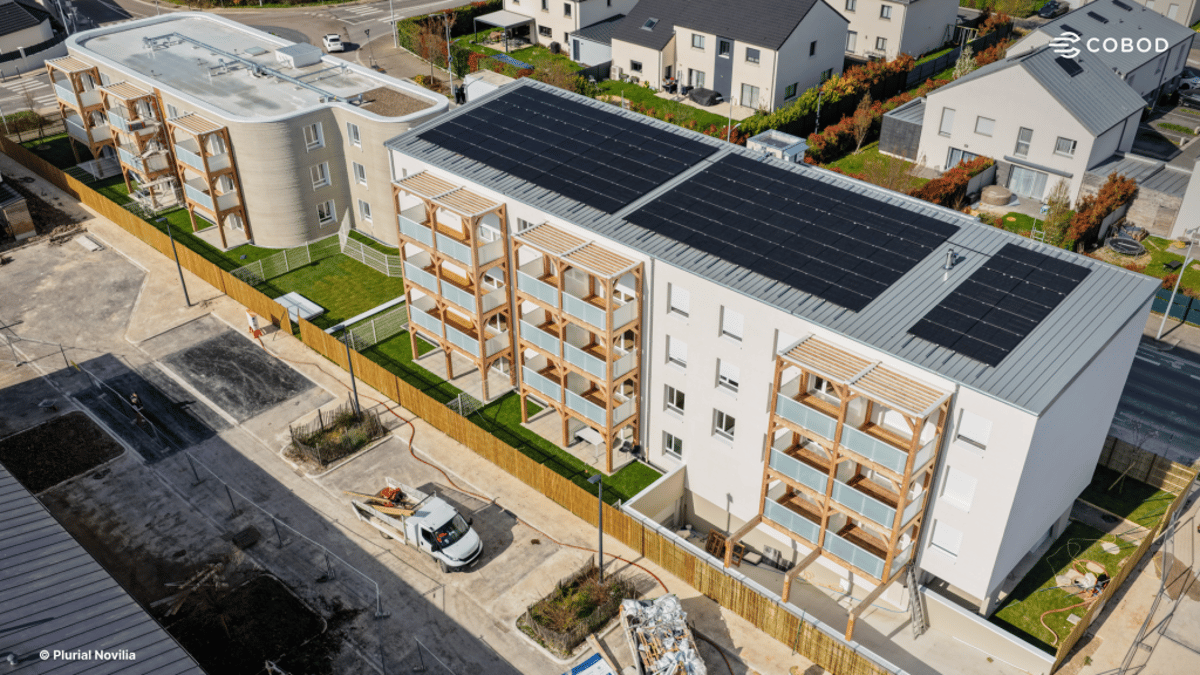
France Just Built Europe’s Largest 3D Printed Apartment Block, Three Months Faster Than Expected
Why It Matters
The speed and resource efficiencies demonstrated prove 3D construction printing can address Europe’s housing shortage and labor constraints, positioning it as a viable, sustainable alternative to traditional building methods.
Key Takeaways
- •12‑unit, 800 m² building printed in 34 days, beating schedule
- •Labor cut by 50%, from six workers to three
- •Material waste halved, concrete use reduced by ~10%
- •Energy self‑sufficiency reaches 60% with 500 m² solar panels
- •Next phase targets 40 apartments, aiming fourfold print‑time cut
Pulse Analysis
The ViliaSprint² project marks a watershed moment for additive manufacturing in the built environment. By completing the load‑bearing structure of a 12‑unit, 800 m² residential block in 34 days, the PERI 3D Construction‑COBOD partnership demonstrated that 3D printing can outpace conventional methods by a margin previously seen only in small‑scale prototypes. The side‑by‑side comparison with an identical conventional build provides hard data on time savings, reinforcing the technology’s credibility among developers, regulators, and financiers.
Beyond speed, the project tackles two chronic industry challenges: labor scarcity and material waste. Reducing the on‑site crew from six to three workers eases pressure on a market already strained by skilled‑trade shortages, while cutting waste from 10% to 5% and lowering concrete volume by roughly 10% translates into measurable cost and carbon‑footprint reductions. The integration of 500 m² of photovoltaic panels and perlite insulation pushes the building toward 60% energy self‑sufficiency, aligning with France’s RE2020 2025 standards and showcasing how 3D printing can enable design‑driven sustainability.
Looking ahead, the planned 40‑apartment expansion, which will deploy two printers simultaneously, aims to achieve a fourfold reduction in print time and bring unit costs close to parity with traditional construction. As scale improves, the technology could reshape policy discussions around affordable housing, accelerate the adoption of net‑zero building codes, and attract investment from firms seeking to mitigate construction risk. The ViliaSprint² success story thus serves as both a proof‑point and a catalyst for broader market acceptance of 3D‑printed architecture.
France Just Built Europe’s Largest 3D Printed Apartment Block, Three Months Faster Than Expected
Comments
Want to join the conversation?
Loading comments...