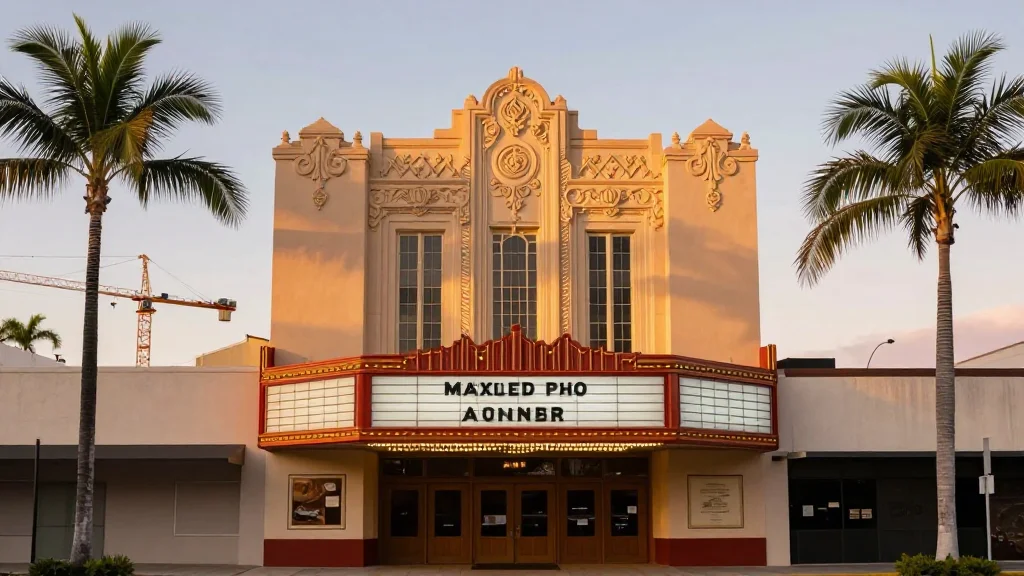
Honolulu Council Advances $4 Million Plan to Acquire and Restore Historic Queen Theater

Companies Mentioned
Why It Matters
The proposed acquisition represents one of the few recent examples of a municipal government directly intervening in the private real‑estate market to preserve a historic asset. If successful, the project could set a precedent for other Hawaiian cities grappling with aging, underutilized properties that sit on valuable urban land. Moreover, the theater’s revival could catalyze economic activity in Kaimuki, a neighborhood that has seen mixed results from recent development initiatives. Conversely, the city’s hesitation underscores the broader challenge of balancing heritage conservation with limited public‑fund resources. Honolulu’s housing shortage and infrastructure deficits mean that every million dollars allocated to a single project is scrutinized for its return on investment. The outcome of Resolution 127 will therefore signal how local policymakers prioritize cultural preservation relative to pressing social needs.
Key Takeaways
- •Council Resolution 127 earmarks up to $4 million for the Queen Theater acquisition
- •Property valued at over $3.9 million; 10,396 sq ft, vacant since 1985
- •Mayor Blangiardi and DHLM cite asbestos, lead paint, mold and structural issues
- •Council aims to designate the site as a government building under the Primary Urban Center Development Plan
- •75‑day review period before the council can appropriate funds; possible eminent‑domain action
Pulse Analysis
Honolulu’s bid to acquire the Queen Theater illustrates a classic tension in urban policy: the desire to preserve cultural landmarks versus the imperative to allocate scarce public funds efficiently. Historically, cities that have taken ownership of historic venues—such as San Francisco’s Alamo Square theater conversion or New York’s adaptive reuse of the Beacon Theatre—have leveraged tax credits, grant programs and private partnerships to offset renovation costs. Honolulu lacks a robust historic‑preservation tax credit framework, which raises the financial risk for the city.
From a market perspective, the theater sits on a parcel that could command a premium if redeveloped for mixed‑use or residential purposes, especially given Kaimuki’s rising demand for walkable, amenity‑rich neighborhoods. However, the site’s environmental liabilities—documented asbestos, lead‑based paint and mold—could easily exceed $2 million in remediation alone, eroding the $4 million acquisition budget. The city would likely need to secure additional state or federal grant funding, or negotiate a public‑private partnership that transfers some risk to private developers while preserving public access.
Politically, the move pits council members who champion community‑focused development against an administration wary of fiscal overreach. The resolution’s language aligns with the Oahu General Plan’s emphasis on “vibrant commercial/mixed‑use corridors,” suggesting that council leaders see the theater as a catalyst for broader corridor revitalization. If the council secures the property and partners with a nonprofit or cultural organization, the project could become a showcase of how public investment in heritage can drive economic uplift without sacrificing fiscal discipline. Failure, however, could reinforce skepticism about municipal real‑estate ventures and stall future preservation efforts.
Honolulu Council Advances $4 Million Plan to Acquire and Restore Historic Queen Theater
Comments
Want to join the conversation?
Loading comments...