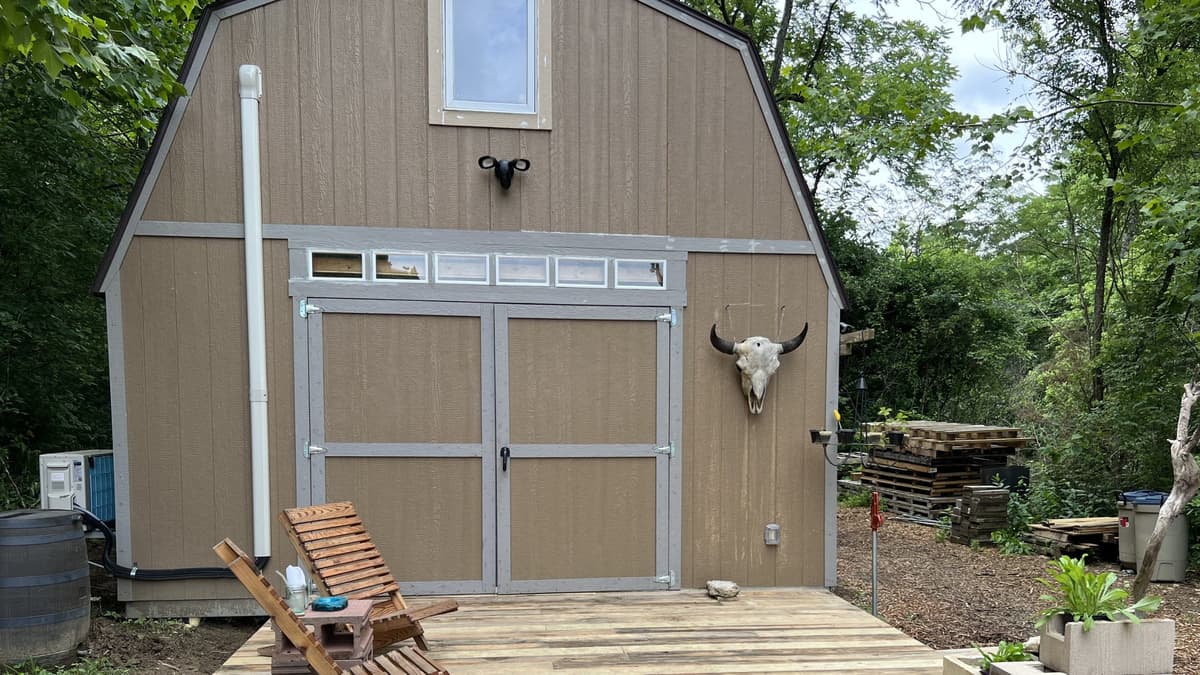
‘I Left New York City and Invested $47K Upgrading a Tuff Shed Into a Tiny House in Kentucky’
•March 1, 2026
0
Why It Matters
The case demonstrates how pandemic‑induced mobility can fuel low‑cost, off‑grid housing demand, challenging traditional real‑estate pricing and prompting new market opportunities for modular builders.
Key Takeaways
- •Tuff Shed converted to tiny home for $47k total
- •12x40 ft shed avoids foundation permits under county ordinance
- •Van life transition often leads to permanent tiny‑home settlement
- •DIY upgrades included insulation, windows, flooring, kitchen, bathroom
- •Social media drives demand for affordable, off‑grid housing solutions
Pulse Analysis
The COVID‑19 pandemic accelerated a shift from urban rentals to remote‑friendly living, and Sophie Goldie’s journey epitomizes that migration. After abandoning a Manhattan brownstone and spending three years in a Sprinter van, she settled on 100 acres in rural Kentucky. There she purchased a 12‑by‑40‑foot Tuff Shed for $23,000 and transformed it into a 480‑square‑foot residence. Her story highlights how portable structures can become permanent homes when location flexibility and lower cost outweigh city amenities.
Goldie’s total investment reached $47,000, a fraction of traditional home prices in comparable markets. The budget included $5,437 for professional spray‑foam insulation, $515 for windows and skylights, $4,000 for flooring, $4,411 for framing and drywall, $1,728 for a modest kitchen, $1,580 for a bathroom, and $2,000 for laundry appliances. Choosing a shed that fits the county’s 12‑by‑40‑foot limit avoided foundation permits and reduced regulatory overhead. The DIY approach—leveraging Facebook Marketplace and personal labor—further compressed expenses, demonstrating a replicable model for cost‑conscious builders.
The project underscores a growing demand for affordable, off‑grid housing solutions, a trend amplified by social‑media exposure. As more urban professionals seek alternatives to high rent, investors and manufacturers are eyeing modular structures, pre‑engineered sheds, and tiny‑home kits. Regulatory flexibility, such as size‑based permit exemptions, can accelerate adoption, while community platforms provide a marketplace for shared knowledge. Goldie’s experience suggests that with modest capital and strategic design, tiny homes can serve as viable primary residences, potentially reshaping niche segments of the real‑estate market.
‘I Left New York City and Invested $47K Upgrading a Tuff Shed Into a Tiny House in Kentucky’
0
Comments
Want to join the conversation?
Loading comments...