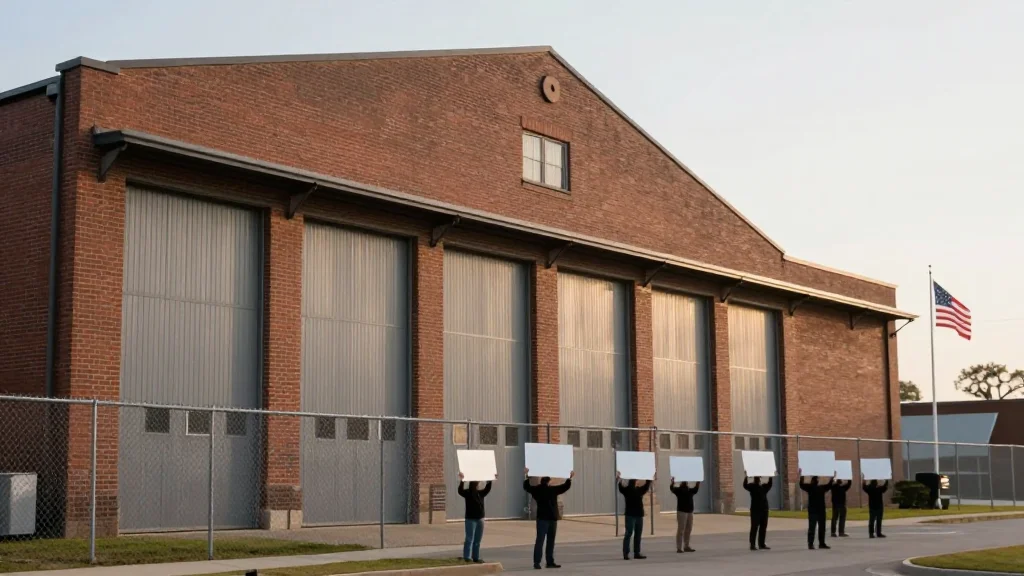
ICE Purchases 825,620‑Sq‑Ft Maryland Warehouse for Detention Center, Sparking Real‑Estate Fight

Why It Matters
The Hagerstown warehouse dispute illustrates how federal policy can directly reshape commercial real‑estate markets, turning vacant industrial space into detention facilities with profound local impacts. Beyond the immediate community concerns—environmental compliance, infrastructure strain, and tax‑base erosion—the case signals a potential shift in how governments acquire and repurpose large‑scale properties, prompting investors and developers to reassess risk profiles for warehouse assets nationwide. If the injunction holds and the lawsuit forces a reversal, it could reinforce the need for rigorous environmental review and community engagement before any similar federal acquisition. Conversely, a ruling that clears the way for the conversion would likely embolden other agencies to target surplus industrial sites, accelerating a trend that could depress values in regions where warehouses become associated with controversial federal uses.
Key Takeaways
- •ICE (DHS) bought an 825,620‑sq‑ft vacant warehouse in Hagerstown, MD in January for a detention center.
- •Local activist Patrick Dattilio grew a Signal group from a few members to 500 in weeks.
- •Maryland AG filed a lawsuit in February alleging missing environmental analysis; a federal judge issued an injunction in April.
- •Washington County Board of Commissioners, all Republicans, passed a resolution supporting DHS and ICE in February.
- •Eight Democratic candidates have declared runs for the county board, up from two four years ago.
Pulse Analysis
The Hagerstown episode underscores a growing tension between federal operational needs and the commercial real‑estate sector's traditional market dynamics. Historically, industrial warehouses have been prized for logistics and e‑commerce expansion; now, they are being eyed as low‑cost, ready‑made facilities for detention purposes. This dual‑use potential introduces a new risk vector for investors, who must now factor in political and regulatory volatility alongside conventional supply‑chain considerations.
From a market perspective, the prospect of government‑driven conversions could depress demand for large, vacant warehouses in politically sensitive regions, as developers may anticipate community pushback or legal hurdles. Conversely, in jurisdictions with more favorable political climates, the same model could create a niche demand, driving up prices for properties that meet specific security and infrastructure criteria. Real‑estate firms will likely begin to incorporate political risk assessments into their acquisition strategies, similar to how they evaluate environmental or zoning constraints today.
Looking ahead, the outcome of the Maryland lawsuit will set a precedent for how rigorously environmental statutes are enforced in the context of federal repurposing. A ruling that upholds the injunction could reinforce the necessity of comprehensive impact studies, potentially slowing future conversions and preserving the traditional industrial market. A decision favoring DHS would signal that federal agencies can bypass certain local safeguards, prompting municipalities nationwide to pre‑emptively tighten ordinances or negotiate protective clauses in future property sales. Either scenario will reshape the calculus for both public officials and private developers navigating the intersection of national policy and real‑estate economics.
ICE Purchases 825,620‑Sq‑Ft Maryland Warehouse for Detention Center, Sparking Real‑Estate Fight
Comments
Want to join the conversation?
Loading comments...