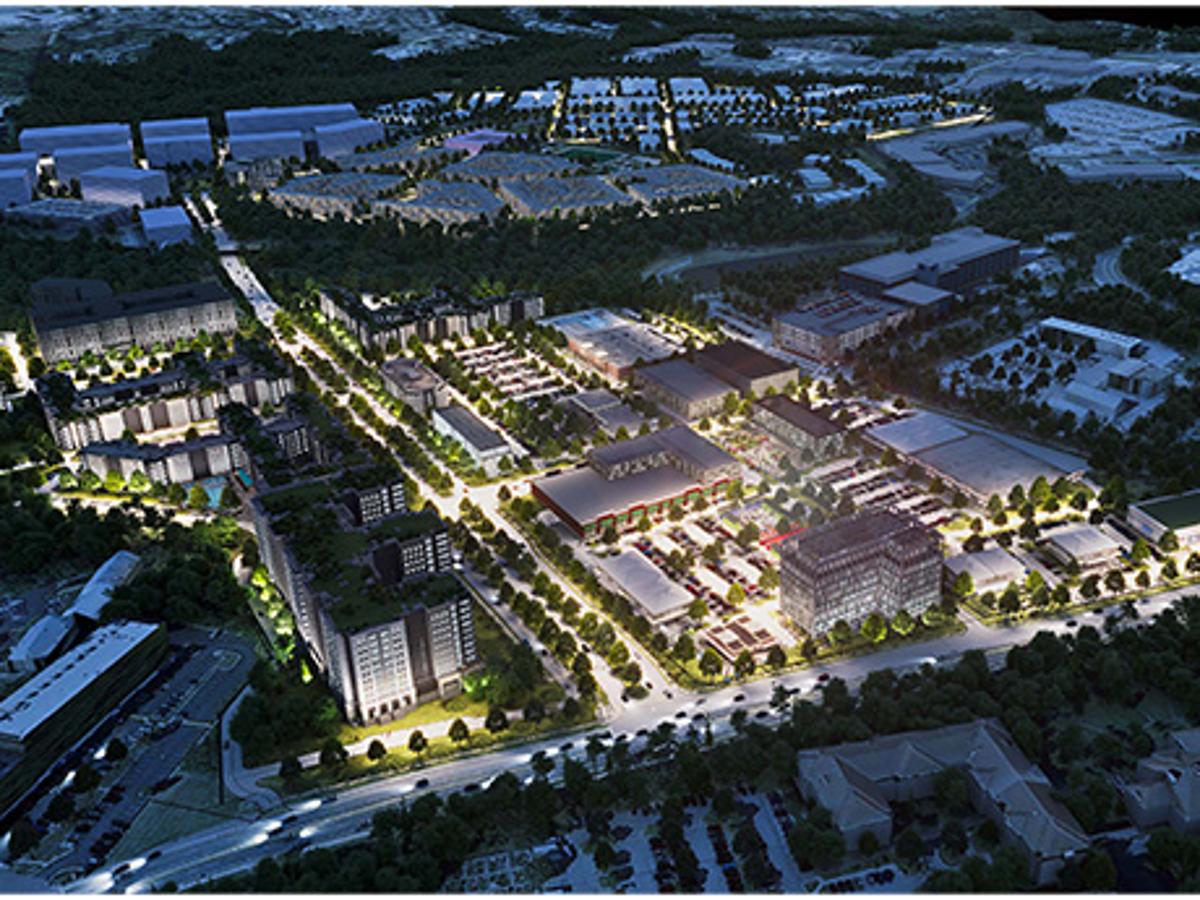
MCB Signs Costco to Anchor $2.8 Billion Viva White Oak Mixed-Use Development in Metro D.C.
•March 4, 2026
0
Why It Matters
The Costco anchor boosts marketability, accelerating leasing and consumer traffic. The TIF financing underscores public‑private collaboration to spur regional economic growth.
Key Takeaways
- •Costco anchors $2.8B Viva White Oak development.
- •Project includes 5,000 new residential units.
- •Montgomery County approved $320M TIF for infrastructure.
- •Expected 17,000 construction jobs, 9,000 permanent jobs.
- •Phase I valued at $1.2B, $33M annual revenue.
Pulse Analysis
Mixed‑use projects have become a cornerstone of suburban revitalization, blending residential, retail, and office functions to create self‑contained neighborhoods. Viva White Oak follows this model on a 280‑acre site just outside Washington, D.C., and its scale—more than 12 million square feet—places it among the region’s most ambitious developments. Securing Costco as an anchor tenant is a strategic move; the warehouse club’s draw guarantees foot traffic and lends credibility that can attract additional national retailers and dining concepts. In markets where consumer preferences favor convenience and experience, such anchors often set the leasing tempo for the entire project.
The Montgomery County Council’s approval of a Tax Increment Financing district marks a rare, first‑ever use of the tool for a private development of this magnitude. By earmarking an estimated $320 million from future property tax increments, the county can fund road upgrades, transit connections, and utility enhancements without burdening current taxpayers. This infusion of public capital reduces the developer’s risk and accelerates construction timelines, which in turn fuels the projected 17,000 construction jobs. Moreover, the TIF framework signals confidence that the development will deliver long‑term fiscal benefits, including $62 million in annual revenue.
For Montgomery County, Viva White Oak promises a transformative economic engine. The addition of 5,000 new homes—both for‑sale and rental—will expand the local housing stock and support a growing workforce attracted by the nearby FDA and medical center. The projected 9,000 permanent jobs across retail, hospitality, and medical office space will diversify employment opportunities beyond the traditional government and health‑care sectors. As the Metro D.C. region continues to grapple with housing shortages and traffic congestion, the project’s integrated design and transit‑oriented infrastructure could become a template for future suburban growth.
MCB Signs Costco to Anchor $2.8 Billion Viva White Oak Mixed-Use Development in Metro D.C.
0
Comments
Want to join the conversation?
Loading comments...