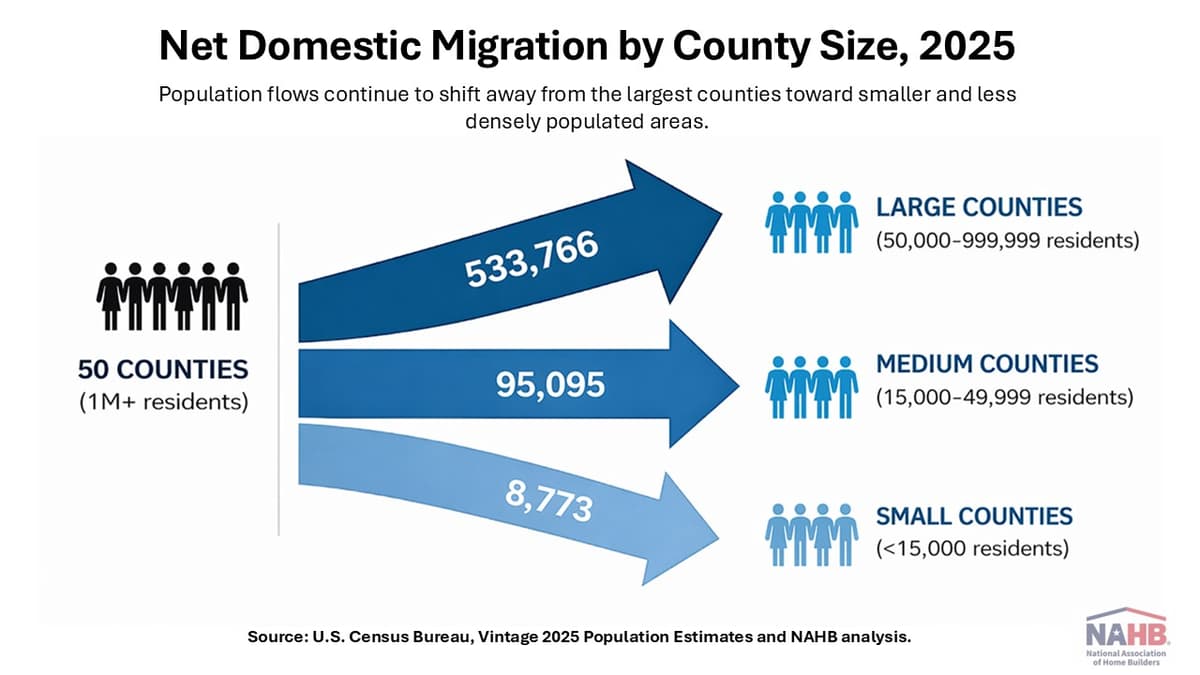
Population Growth and Housing Supply Dynamics at the County Level in 2025
Why It Matters
Understanding the jobs‑population‑housing nexus guides policymakers and developers toward targeted investment, preventing housing shortages and supporting sustainable growth.
Key Takeaways
- •Job growth drives net migration in high‑opportunity counties
- •Population inflows outpace housing starts in many Sun Belt regions
- •Construction lag creates affordability gaps in fast‑growing metros
- •States with diversified economies see more balanced housing supply
- •County‑level data reveals mismatches hidden in state‑wide aggregates
Pulse Analysis
The interplay between employment, migration, and housing supply has become a focal point for regional planners as the United States approaches the mid‑2020s. Counties that attract new firms—particularly in technology, advanced manufacturing, and renewable energy—experience a surge in job openings that pulls workers from elsewhere. This inbound migration raises demand for rental units and home purchases, often faster than local building permits can accommodate. When construction pipelines lag, price appreciation accelerates, squeezing both new arrivals and existing residents. By examining job growth rates alongside population change at the county level, analysts can pinpoint where housing pipelines are most vulnerable and where policy interventions, such as streamlined permitting or targeted subsidies, may be most effective.
Data from the Bureau of Labor Statistics and the Census Bureau reveal that the strongest correlations between job creation and net in‑migration occur in states like Texas, Florida, and Arizona, where diversified economies and business‑friendly regulations attract talent. However, the housing response varies: some counties, such as Austin‑Metro and Charlotte‑County, have expanded building activity through public‑private partnerships, while others, like parts of the Inland Empire, struggle with land‑use constraints and labor shortages in construction. These disparities underscore the importance of localized metrics rather than relying solely on state‑wide averages.
For developers and investors, the takeaway is clear: aligning project pipelines with counties demonstrating robust job growth can mitigate risk and capture upside. Municipalities, meanwhile, can use these insights to calibrate zoning reforms, infrastructure spending, and workforce housing programs. By integrating real‑time employment data with migration trends, stakeholders can better anticipate housing demand, reduce vacancy cycles, and foster more resilient regional economies.
Population Growth and Housing Supply Dynamics at the County Level in 2025
Comments
Want to join the conversation?
Loading comments...