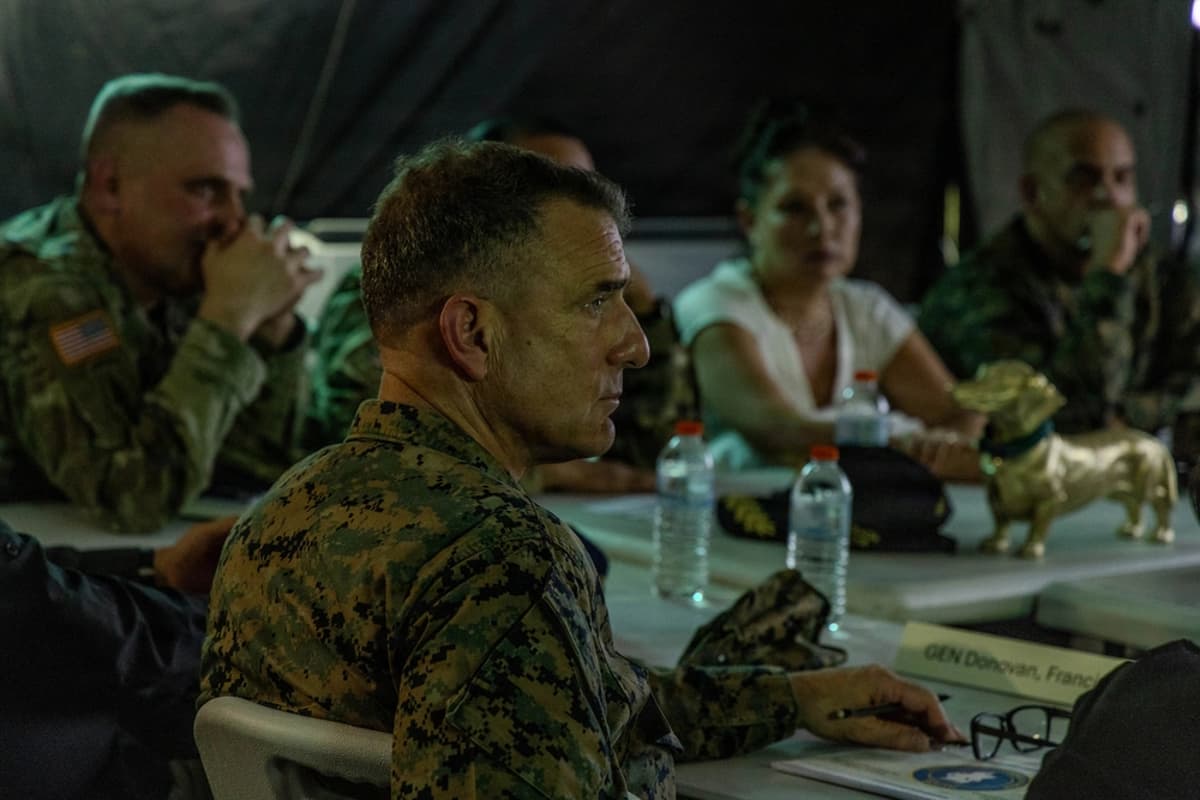
US Southern Command Stands up Autonomous Unit
Why It Matters
SAWC signals an accelerated U.S. commitment to AI‑enabled warfare in Latin America, enhancing both security cooperation and American influence in a geopolitically sensitive region.
Key Takeaways
- •SAWC will coordinate autonomous, semi-autonomous, and unmanned platforms across domains.
- •Command aims to degrade narcoterrorist and cartel networks in the Western Hemisphere.
- •Collaboration with Defense Autonomous Warfare Group and Space Force to integrate capabilities.
- •Southcom’s area covers Caribbean, Central and South America, ideal for tech testing.
- •Unit underscores US emphasis on AI-driven warfare to bolster regional stability.
Pulse Analysis
The establishment of the Autonomous Warfare Command marks a decisive step in the Pentagon’s strategy to embed artificial intelligence and unmanned systems into everyday operations. By consolidating autonomous air, maritime, cyber and space assets under a single Southern Command umbrella, the U.S. military aims to streamline decision‑making and reduce the latency between intelligence collection and kinetic action. This structural shift mirrors similar moves in Europe and the Indo‑Pacific, where dedicated AI units are being tasked with rapid, data‑driven responses to emerging threats.
In the Western Hemisphere, SAWC’s mandate dovetails with longstanding concerns over narcoterrorism, illicit trafficking, and the increasing frequency of natural disasters. Leveraging satellite communications, positioning, navigation and timing services from Space Force, the command can provide persistent surveillance and precision strike capabilities to partner nations. Joint exercises with regional militaries are expected to accelerate technology transfer, fostering a network of interoperable platforms that can collectively degrade criminal networks while preserving sovereign decision‑making.
Beyond immediate operational benefits, SAWC exemplifies a broader trend toward autonomous warfare that raises policy and ethical questions. Integrating AI at scale demands robust governance, clear rules of engagement, and safeguards against unintended escalation. As the United States deepens its AI footprint in Latin America, it must balance technological advantage with diplomatic sensitivity, ensuring that the pursuit of efficiency does not undermine regional stability or provoke adversarial counter‑measures. The success of SAWC will likely influence future force design across all combatant commands.
US Southern Command stands up autonomous unit
Comments
Want to join the conversation?
Loading comments...