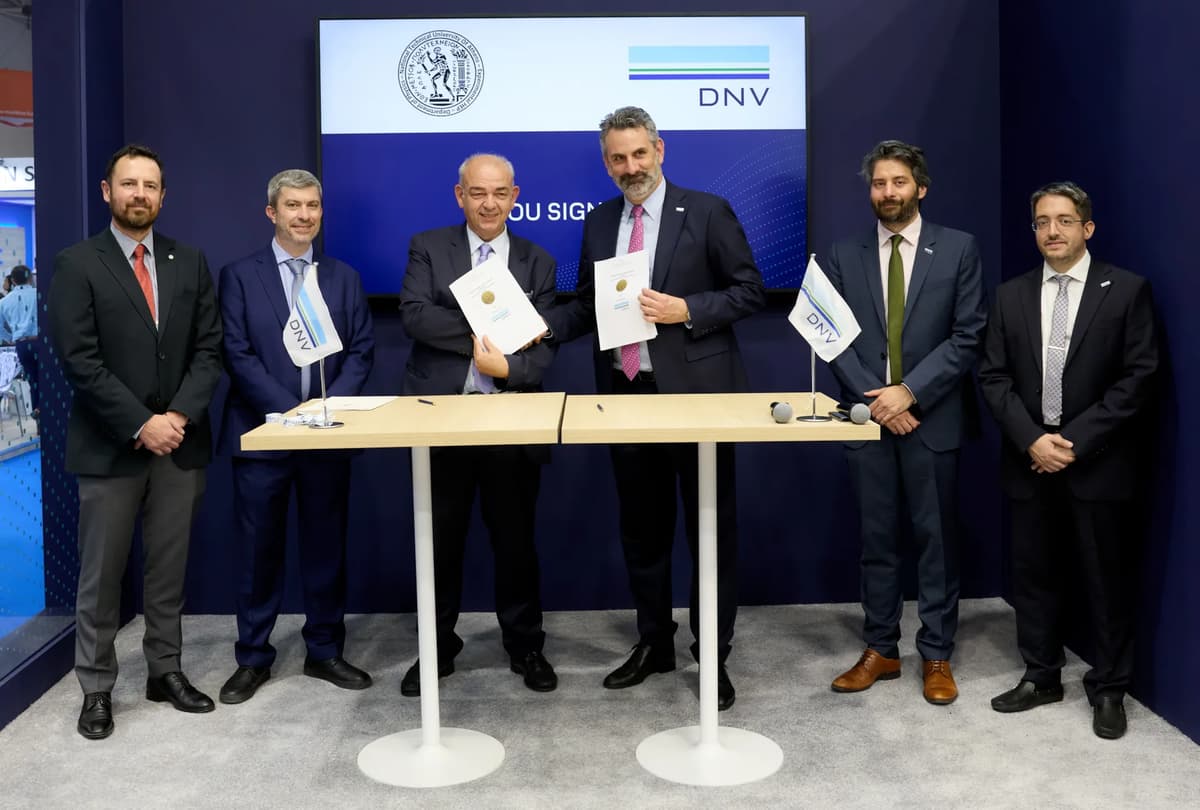
DNV and NTUA Expand Maritime Cooperation with New Research Agreement
Key Takeaways
- •Joint projects target clean energy, digitalization, and safety technologies
- •NTUA students gain hands‑on experience with DNV’s classification tools
- •Partnership strengthens Greek shipping’s talent pipeline and global competitiveness
- •Collaboration aligns with EU maritime decarbonization targets and funding programs
Pulse Analysis
The shipping industry is at a crossroads, facing stricter emissions regulations and a rapid shift toward digital operations. DNV, a global leader in classification and technical assurance, has been instrumental in defining standards for low‑carbon vessels and autonomous navigation. Meanwhile, the National Technical University of Athens, Greece’s premier engineering school, has supplied generations of naval architects and marine engineers to the nation’s fleet. Their new memorandum of understanding, signed at the world‑renowned Posidonia 2026 trade fair, formalizes a joint effort to tackle these systemic challenges through coordinated research and innovation.
The MOU outlines a multi‑track collaboration that will cover advanced maritime technologies, clean‑energy propulsion, and safety‑critical digital systems. By embedding DNV’s classification data and operational insights into NTUA’s graduate programs, students will work on real‑world case studies ranging from hydrogen‑fuelled hull designs to AI‑driven condition monitoring. Separate project agreements will be negotiated as ideas mature, creating a pipeline of funded research that can be rapidly transferred to shipyards and owners. This hands‑on model not only enriches academic curricula but also shortens the time‑to‑market for breakthrough solutions.
The partnership arrives as the European Union tightens its maritime decarbonization roadmap, offering substantial funding for collaborative research. For Greece, whose economy relies heavily on shipping, the alliance promises to retain talent domestically and reinforce the country’s reputation as a hub of maritime expertise. Industry observers expect that the DNV‑NTUA synergy will generate standards‑compliant technologies that can be exported to other flag states, amplifying the competitive advantage of Greek shipowners. In the longer term, the collaboration could serve as a template for academia‑industry links across the global maritime sector.
DNV and NTUA expand maritime cooperation with new research agreement
Comments
Want to join the conversation?