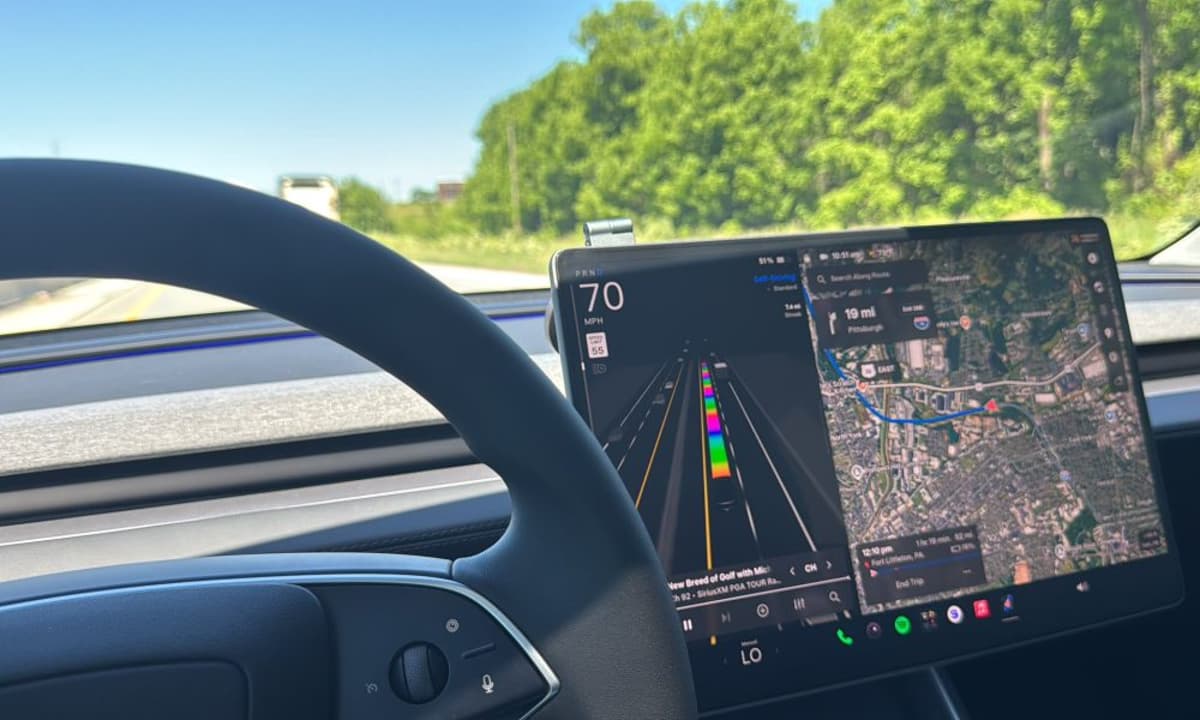
Tesla Full Self-Driving Attempts 150-Mile Stress Test: The Good and the Bad
Key Takeaways
- •150‑mile test shows FSD v14.3.3 handles lane‑ending arrows
- •System safely yields to veering tractor‑trailer and respects tunnel lane rules
- •Toll‑by‑plate plazas navigated smoothly without driver intervention
- •Parking at Superchargers still requires manual takeover
- •Destination‑lot confusion indicates need for better parking‑lot AI
Pulse Analysis
Tesla’s Full Self‑Driving (FSD) beta continues its rapid evolution, and the recent 150‑mile stress test on the Pennsylvania Turnpike offers a rare, real‑world benchmark. Running version 14.3.3, the Model Y demonstrated a marked improvement in highway cognition, correctly recognizing lane‑ending arrows and aborting risky passes. Its ability to anticipate a merging tractor‑trailer and shift onto the shoulder shows a nuanced understanding of heavy‑vehicle dynamics, while strict adherence to tunnel lane‑keeping rules reflects progress toward regulatory‑friendly behavior. Even the transition to “Toll by Plate” plazas was handled without a hitch, underscoring Tesla’s focus on seamless integration with evolving infrastructure.
These strengths matter because they address two of the most scrutinized aspects of autonomous driving: safety in high‑speed traffic and compliance with static road cues. By reliably managing complex scenarios such as lane merges, tunnel constraints, and toll interactions, FSD v14.3.3 narrows the gap between driver‑assist and true autonomy, potentially easing the path for broader market acceptance and insurance‑industry endorsement. Competitors like Waymo and Cruise still rely on extensive sensor suites, whereas Tesla leans on vision‑only AI; each successful highway maneuver bolsters the case that a camera‑centric approach can scale.
Nevertheless, the test exposed lingering weaknesses that could stall consumer confidence. Repeated parking mishaps at Superchargers and a baffling loop in a destination lot reveal that low‑speed, confined‑space navigation remains a blind spot for Tesla’s neural net. As autonomous vehicles move from highways to the curb, solving these micro‑maneuver challenges will be essential for a truly hands‑free experience. Tesla’s roadmap, which promises incremental updates, must prioritize robust parking algorithms and lot‑level mapping if it hopes to outpace rivals and deliver on the promise of full autonomy.
Tesla Full Self-Driving attempts 150-mile stress test: the good and the bad
Comments
Want to join the conversation?