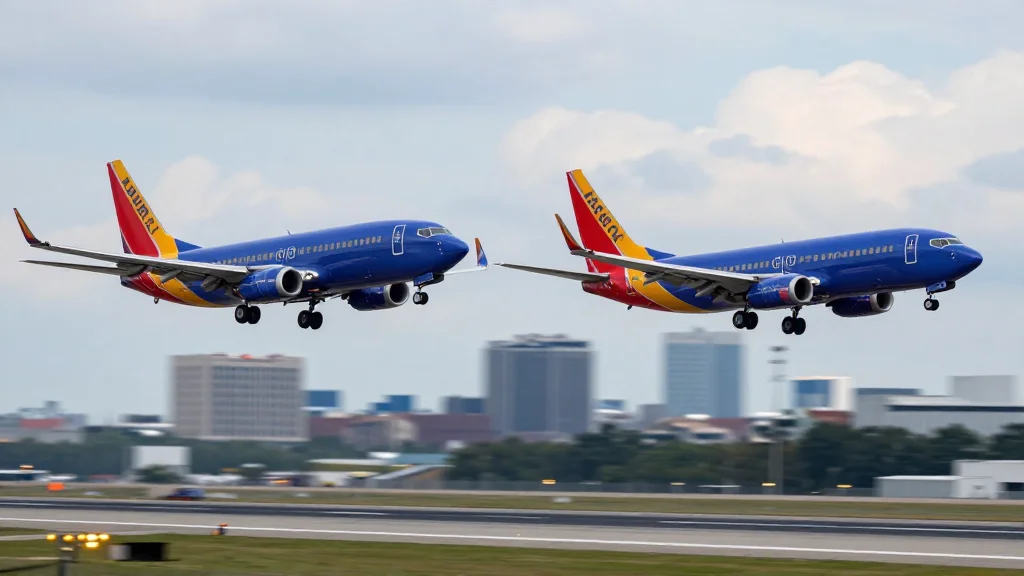
Two Southwest Airlines Planes Nearly Collide Mid-Air As They Come Within 500 Feet of One Another Over Nashville
Key Takeaways
- •Southwest flights WN-507 and WN-1152 passed within 500 ft vertically.
- •ATC instruction mistakenly crossed inbound plane into departing aircraft’s path.
- •TCAS issued a resolution advisory, preventing collision.
- •Both planes landed safely; no injuries reported.
- •Incident underscores scrutiny of parallel runway and go‑around procedures.
Pulse Analysis
The Nashville incident underscores how a single ATC miscommunication can cascade into a dangerous mid‑air encounter, even with modern safety nets in place. Flight WN‑507, executing a go‑around due to gusty conditions, was instructed to turn right at 2,000 feet, intersecting the climb path of WN‑1152 departing for Knoxville. The aircraft’s Traffic Alert and Collision Avoidance System (TCAS) detected the conflict and issued a resolution advisory, prompting immediate corrective action. This automated safeguard proved decisive, allowing both crews to maintain separation and complete their flights without injury.
Beyond the immediate drama, the event revives industry debate over the use of parallel runways and go‑around procedures in high‑traffic hubs. The FAA’s recent decision to ban parallel landings at San Francisco International highlights growing concerns about runway geometry, controller workload, and pilot workload during simultaneous arrivals and departures. Nashville’s dual‑runway configuration, while efficient under normal conditions, can become a choke point when weather prompts unexpected go‑arounds. Regulators may now examine sequencing algorithms, controller training, and real‑time conflict detection to reduce reliance on pilot‑initiated maneuvers.
Looking ahead, airlines and the FAA are likely to tighten procedural checks and invest in next‑generation surveillance technologies. Enhancements to ADS‑B data sharing, predictive conflict modeling, and tighter integration between ground‑based radar and onboard TCAS could provide earlier warnings. Southwest’s cooperation with investigators signals a proactive stance, but the broader lesson is clear: robust human‑machine collaboration remains essential to preserving safety in increasingly congested skies.
Two Southwest Airlines Planes Nearly Collide Mid-Air As They Come Within 500 Feet of One Another Over Nashville
Comments
Want to join the conversation?