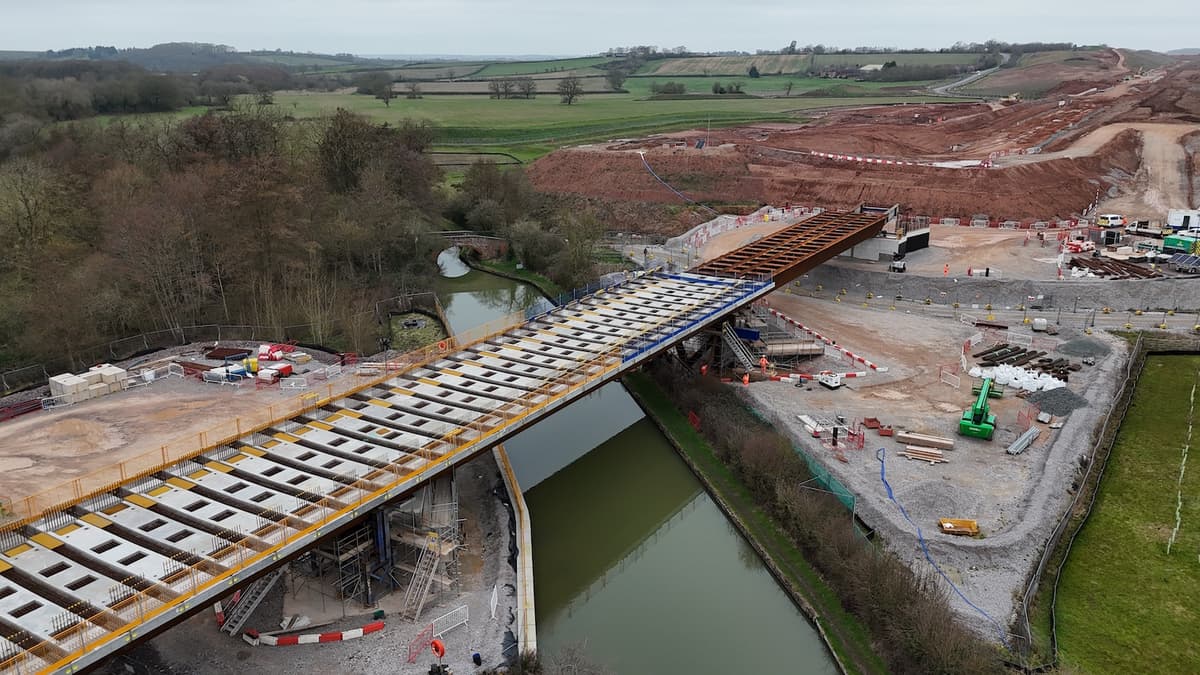
Video | HS2 Slides 1,620t Bridge over Grand Union Canal
•March 10, 2026
0
Key Takeaways
- •1,620‑ton bridge slid in two days, ahead of schedule.
- •Hydraulic jacks moved deck at up to 10 m/hour.
- •34 piles driven up to 30 m deep for support.
- •Coordination with Canal & River Trust protected historic canal.
- •Project showcases Balfour Beatty Vinci’s engineering expertise.
Summary
HS2 engineers have successfully launched a 130‑metre, 1,620‑ton steel bridge (Longhole Viaduct) over the Grand Union Canal near Ufton, Warwickshire, completing the slide operation in two days and reopening a 1.5‑mile section a week ahead of schedule. The bridge was moved using hydraulic jacks and Teflon‑coated pads at up to 10 m per hour, after extensive preparatory works including 34 deep piles and new retaining walls. The project, led by Balfour Beatty Vinci, involved a 40‑person team and close coordination with the Canal & River Trust to protect the historic canal and nearby Grade II‑listed bridge. The viaduct will soon carry HS2 trains from the Long Itchington Wood Tunnel toward the Welsh Road embankment.
Pulse Analysis
The Longhole Viaduct represents a critical link in HS2’s central corridor, bridging the Grand Union Canal and clearing the path for high‑speed trains to emerge from the Long Itchington Wood Tunnel. By employing a ‘skid shoe’ methodology—hydraulic jacks paired with low‑friction Teflon‑coated pads—engineers achieved a controlled slide of a 1,620‑ton steel deck at roughly 10 metres per hour. This technique, often reserved for large‑scale bridge installations, underscores the project’s commitment to precision engineering while adhering to a compressed timeline.
Beyond the mechanical feat, the operation demanded meticulous environmental stewardship. Over 34 piles were driven up to 30 metres deep, and a new concrete‑capped retaining wall replaced a century‑old wash wall to safeguard the canal’s structural integrity. Continuous vibration monitoring protected the adjacent Grade II‑listed Longhole Bridge, and close collaboration with the Canal & River Trust ensured minimal disruption for boaters during the canal’s ‘close season.’ Such proactive measures reflect a broader industry trend toward integrating heritage preservation with modern infrastructure development.
Strategically, completing the viaduct a week ahead of schedule sends a strong signal to stakeholders about HS2’s capacity to accelerate delivery without compromising safety or community relations. The success bolsters confidence in subsequent phases, particularly the extensive embankments and cuttings that will link this segment to the wider network. For contractors and civil‑engineering firms, the project serves as a benchmark for large‑scale bridge sliding operations, highlighting the value of advanced hydraulic systems, precise planning, and stakeholder coordination in achieving on‑time, on‑budget outcomes.
Comments
Want to join the conversation?