Why Your Freight Costs Are Rising Even When Volumes Stay Flat
Key Takeaways
- •Diesel price hit $5.64/gal, adding ~40¢/mile surcharge.
- •94% of carriers say fuel costs affect load decisions.
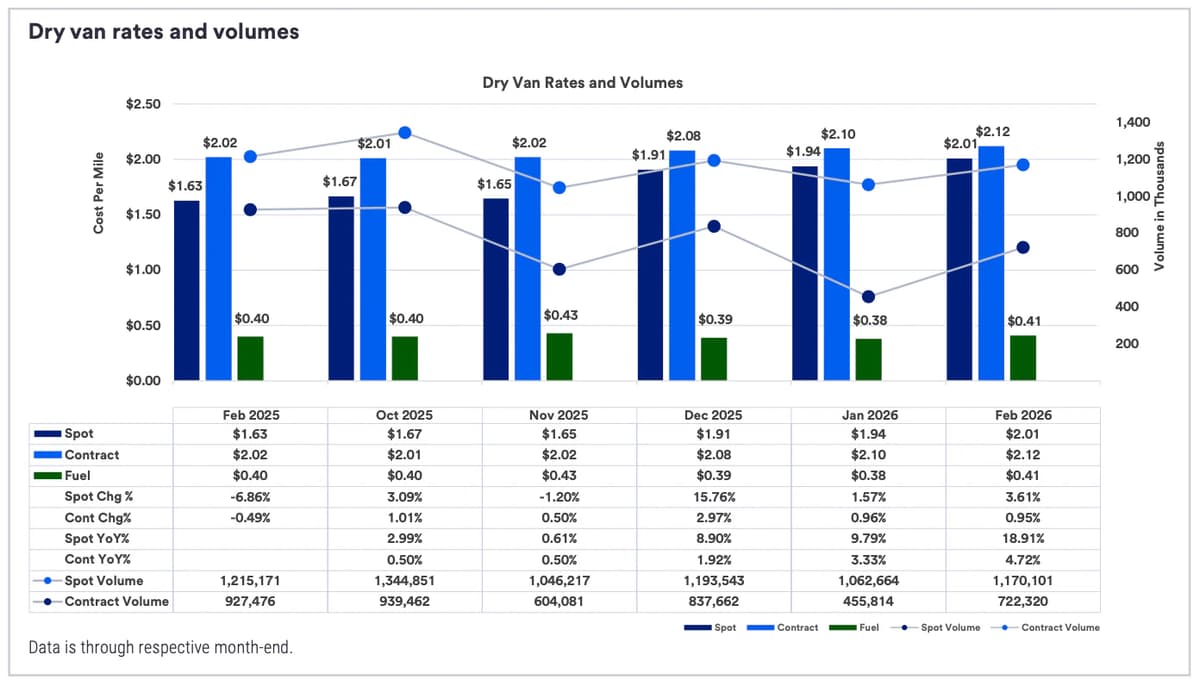
- •Spot rates rose to $2.01/mile; contract rates to $2.12/mile.
- •Spot‑contract premium narrowed to $0.11/mile from $0.39.
- •Spot volume down 3.7%; contract volume down 22.1%.
Pulse Analysis
The recent diesel price spike, now averaging $5.64 per gallon, stems from heightened geopolitical tension in the Middle East, notably the Iran‑U.S. cease‑fire negotiations. Carriers without fuel‑hedging strategies face a direct cost increase of roughly 40 cents per mile, prompting many to adjust routing and load size. This pressure is reflected in a DAT survey where 94% of carriers report fuel costs influencing load acceptance, and nearly half are actively seeking shorter, lighter hauls to preserve margins.
At the same time, the freight market is experiencing a notable convergence between spot and contract pricing. Spot linehaul rates rose to $2.01 per mile in February 2026, while contract rates edged to $2.12 per mile, compressing the premium to just $0.11 per mile—a sharp decline from the $0.39 gap a year earlier. Despite these rate gains, overall freight volumes have slipped, with spot volume down 3.7% and contract volume down 22.1%, indicating carriers are exercising tighter capacity discipline rather than responding to demand growth.
Looking ahead, shippers must adapt to a landscape where cost recovery is increasingly tied to fuel surcharges and spot‑rate volatility. Even if the cease‑fire eases oil price pressures, analysts warn that diesel prices are unlikely to revert to pre‑conflict levels soon, keeping upward pressure on transportation budgets. Best practices include aligning routing guides with carriers that can manage fuel risk, closely monitoring spot‑contract spreads by lane, and building flexible budget buffers to accommodate sudden rate spikes. These steps can help mitigate the impact of a supply‑driven rate environment on bottom‑line performance.
Why Your Freight Costs Are Rising Even When Volumes Stay Flat
Comments
Want to join the conversation?