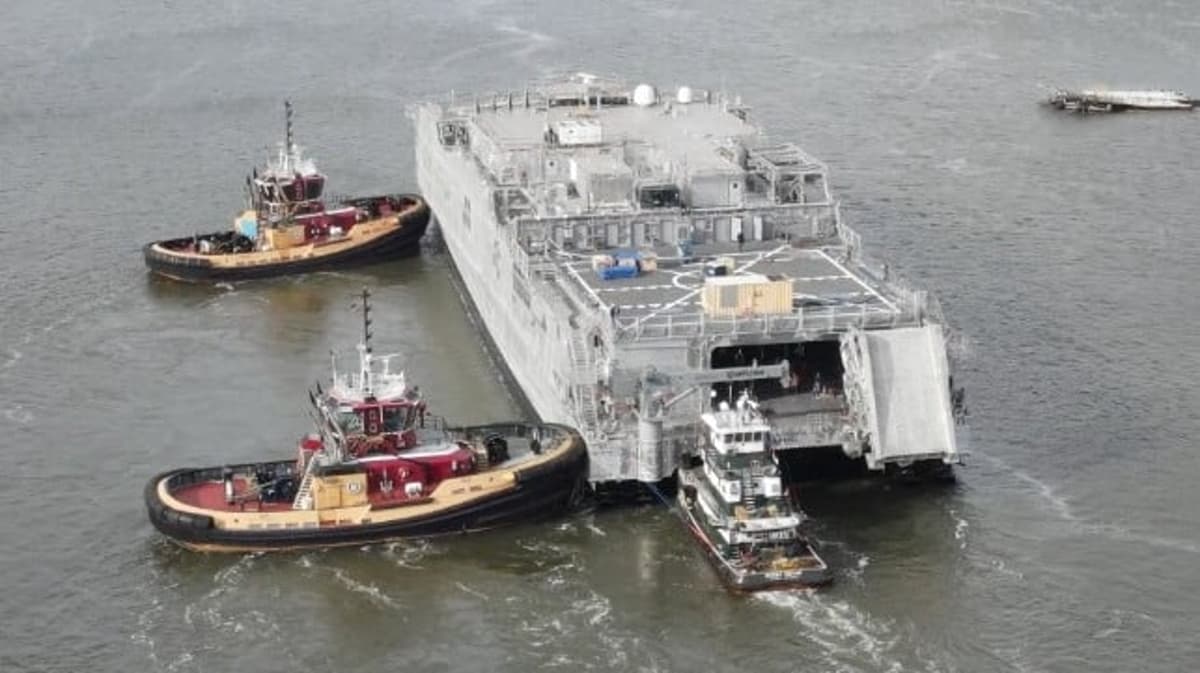
Austal USA Launches Final EPF - Future USNS Lansing (EPF 16)
•February 28, 2026
0
Why It Matters
The delivery of the last EPF strengthens the Navy’s rapid‑response logistics and expands its medical evacuation fleet, while showcasing U.S. shipbuilding resilience.
Key Takeaways
- •Final EPF (EPF‑16) launched at Austal USA facility
- •26th ship launched using modular transport process
- •EPF‑16 will be third Flight II medical variant
- •Launch supports Navy’s rapid‑deployment logistics capability
- •Partnerships streamline shipbuilding milestones and industrial base
Pulse Analysis
The Expeditionary Fast Transport program, initiated in 2009, was designed to provide the U.S. Navy with high‑speed, shallow‑draft vessels capable of moving troops, equipment, and humanitarian aid across littoral zones. Built on a catamaran hull with aluminum construction, EPFs can cruise at 35‑40 knots and operate in austere ports, filling a niche between traditional amphibious ships and smaller landing craft. Over the past decade, the fleet has evolved from basic transport to specialized variants, including the Flight II medical configuration that adds advanced patient care facilities and surgical suites, enhancing the Navy’s surge medical capability.
Austal USA’s launch of USNS Lansing demonstrates the maturity of its modular shipbuilding approach. By employing self‑propelled modular transporters to lift and shift the hull onto a barge, the company reduces reliance on fixed slipways and accelerates the transition from assembly to sea‑trial preparation. This method, now used for 26 vessels, minimizes handling risks and shortens the critical path between hull completion and outfitting. The collaboration with partners such as Berard Transportation and Alabama Shipyard further streamlines logistics, reinforcing the domestic maritime industrial base and providing a template for future high‑tempo production cycles.
The final EPF’s entry into service carries strategic weight. As the third Flight II medical variant, USNS Lansing will augment the Navy’s ability to deliver forward‑deployed health services during combat operations, disaster response, and pandemic relief. Its high speed and shallow draft enable rapid access to remote or damaged ports, a capability increasingly valued in a climate of dispersed threats and humanitarian crises. For defense contractors, the successful completion of the EPF line signals sustained demand for modular, fast‑track shipbuilding, potentially influencing upcoming programs such as the Large Surface Combatant and next‑generation sealift platforms.
Austal USA Launches Final EPF - Future USNS Lansing (EPF 16)
0
Comments
Want to join the conversation?
Loading comments...