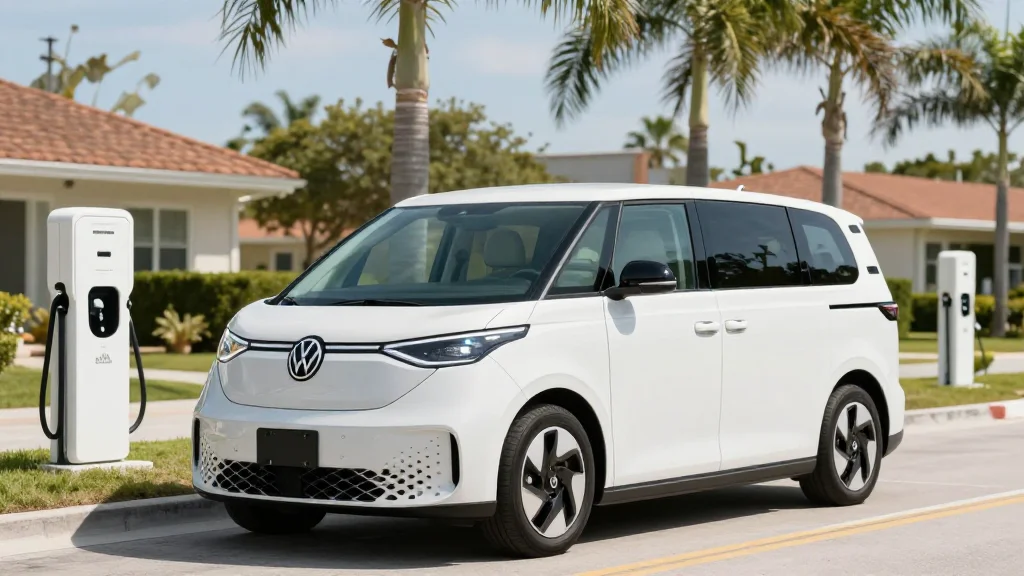
Autonomous VW Buses to Begin Microtransit Service in Florida Community
Companies Mentioned
Why It Matters
The rollout demonstrates how autonomous vehicles can augment public transit, lowering costs while extending first‑ and last‑mile connectivity, a critical factor for urban mobility and sustainability goals.
Key Takeaways
- •Beep tests six 4‑passenger ID.Buzz shuttles in Lake Nona.
- •Partnership targets up to 5,000 autonomous buses across Florida and beyond.
- •Service aims to undercut ride‑hailing prices while linking to transit.
- •Accessibility options like wheelchair lifts planned for future fleets.
- •Cities need two‑year planning for microtransit infrastructure.
Pulse Analysis
The Beep‑Moia collaboration arrives at a moment when autonomous vehicle (AV) technology is moving from pilot projects to commercial scale. Volkswagen’s ID.Buzz platform, originally conceived as a modern electric reinterpretation of the classic micro‑bus, provides a low‑cost, purpose‑built chassis that can accommodate the sensor suites and computing power required for driverless operation. By pairing the vehicle with Beep’s software stack, the joint venture sidesteps the need for costly retrofits, accelerating time‑to‑market and positioning the fleet as a template for other municipalities seeking plug‑and‑play AV solutions.
From a transit perspective, autonomous microtransit fills a niche between fixed‑route buses and private ride‑hailing services. By offering on‑demand rides that feed into scheduled circulators, the service can smooth peak‑hour loads, improve first‑ and last‑mile access, and reduce reliance on personal vehicles. Pricing below typical ride‑hailing rates makes the offering attractive to cost‑sensitive riders, while planned accessibility upgrades—wheelchair lifts and ramps—address equity concerns often raised about emerging mobility platforms. Infrastructure upgrades such as transit signal priority and dedicated cellular networks further enhance reliability, a key metric for public agencies evaluating AV pilots.
Looking ahead, scaling to the projected 5,000‑vehicle fleet will test the partnership’s ability to navigate regulatory hurdles, data‑privacy standards, and public acceptance. Competition is intensifying, with firms like Cruise, Waymo and local transit agencies experimenting with similar models. Success will hinge on robust safety validation, seamless integration with existing transit schedules, and clear policy frameworks that balance innovation with community safeguards. If Beep and Moia can demonstrate consistent on‑time performance and cost savings, they could set a new benchmark for driverless public mobility across the United States.
Autonomous VW buses to begin microtransit service in Florida community
Comments
Want to join the conversation?
Loading comments...