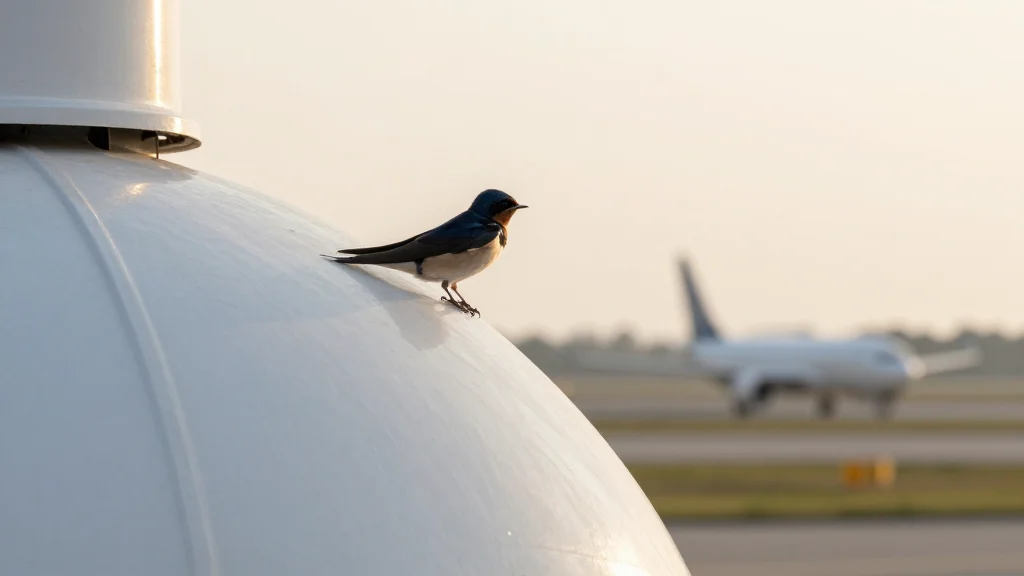
Avian Radar to Protect Birds at King Shaka International Airport
Why It Matters
Real‑time bird tracking reduces aircraft‑bird strike risk while supporting biodiversity, setting a new safety‑environment standard for airports worldwide.
Key Takeaways
- •MAX radar offers 15 km range and 60 rpm rotation speed.
- •Up to three million barn swallows gather nightly near KSIA.
- •First African airport using 3D avian radar technology.
- •Real‑time bird tracking improves flight safety and biodiversity protection.
Pulse Analysis
Airports worldwide face a paradox: the need to keep runways clear while preserving the natural habitats that surround them. At Durban’s King Shaka International Airport, the collision risk posed by nightly roosts of up to three million barn swallows has prompted a pioneering solution. HENSOLDT South Africa partnered with Robin Radar to install the MAX avian radar, a purpose‑built 3‑D system that delivers 360° coverage and a 15‑kilometre detection radius. Rotating at 60 revolutions per minute—the fastest in the market—the radar provides real‑time altitude and position data, allowing air traffic controllers to anticipate bird movements and adjust flight paths before a potential strike.
Beyond immediate safety, the deployment creates a valuable scientific dataset. Researchers from the University of KwaZulu‑Natal are cross‑referencing field observations with radar signatures, enriching a species‑specific database that can refine detection algorithms. This collaboration illustrates how commercial aviation can serve as a platform for ecological monitoring, turning a safety tool into a biodiversity asset. By quantifying migration patterns over the airport’s airspace, stakeholders gain insights that inform both conservation strategies and regulatory frameworks governing wildlife‑aircraft interactions.
The successful rollout at King Shaka positions the MAX system as a benchmark for other African hubs and for airports on any continent seeking to balance operational efficiency with environmental stewardship. As airlines confront stricter safety mandates and growing public pressure to protect wildlife, demand for high‑resolution avian radar is likely to accelerate. Companies that can integrate radar data with existing air‑traffic management platforms stand to capture new revenue streams, while regulators may soon codify such technology as a best‑practice requirement for airports located near major migratory corridors.
Avian radar to protect birds at King Shaka International Airport
Comments
Want to join the conversation?
Loading comments...