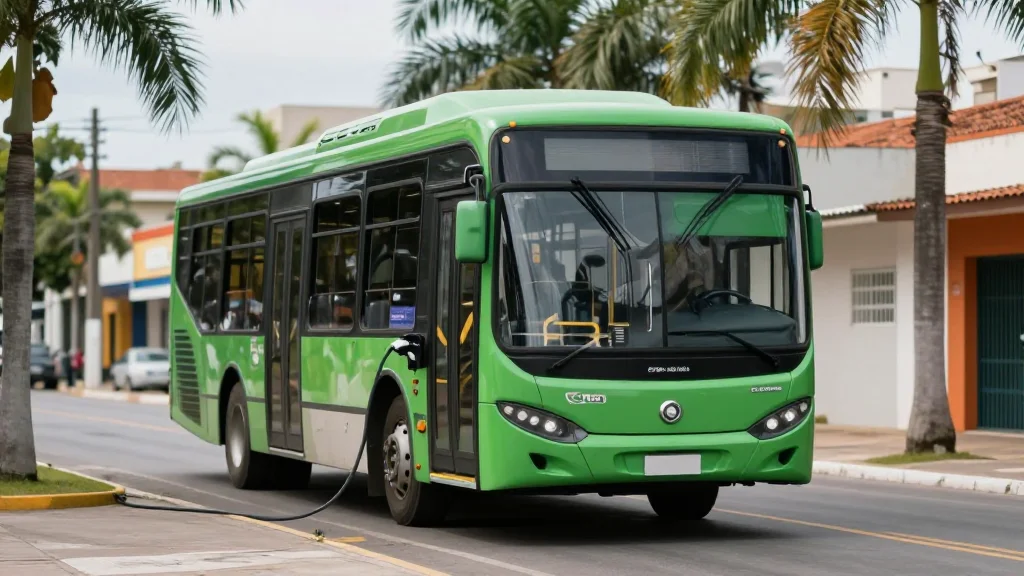
Brazil’s Public Transit Skews To Electric
Companies Mentioned
Why It Matters
The transition eliminates over two million tons of lifecycle CO₂, positioning Brazil as a low‑carbon mobility leader and unlocking a sizable market for charging infrastructure and grid services.
Key Takeaways
- •Brazil has 1,500 electric buses across 30 cities as of early 2026
- •São Paulo hosts the majority, leveraging World Bank and BNDES funding
- •Depot power upgrades are the main bottleneck for scaling fleets
- •New E‑Bus Energy Sizing Tool guides precise charging infrastructure planning
Pulse Analysis
Brazil’s electric‑bus surge mirrors a global push toward zero‑emission public transport, yet the country’s pace is notable. By early 2026, roughly 1,500 battery‑electric buses operate in nearly thirty municipalities, with São Paulo accounting for the bulk of the fleet. This growth is underpinned by a blend of municipal ambition and financing from the National Development Bank, the World Bank, and the Inter‑American Development Bank, aligning with Brazil’s revised Growth Acceleration Program that envisions 38,000 renewable‑powered buses by 2035.
The most pressing obstacle is the so‑called “depot wall.” As fleets expand, the demand for reliable, high‑capacity charging infrastructure outpaces existing grid capabilities. Upgrading substations and installing sufficient chargers entail significant upfront capital and lengthy lead times, often delaying procurement schedules. Moreover, a one‑size‑fits‑all charger‑to‑bus ratio proves ineffective; a 150 kW charger may support anywhere from two to eight buses depending on route profiles and depot layouts. Accurate sizing therefore becomes critical to avoid costly over‑building or crippling power shortages during peak service hours.
To overcome these challenges, Brazil is adopting sophisticated planning tools such as the E‑Bus Energy Sizing Tool, which simulates depot power requirements based on battery capacity, charger output, and route energy consumption. Initiatives like the Mutirão Brasil program, backed by C40 and GCOM, are deploying this modeling across eight cities, preparing for an additional 600 electric buses in the coming year. As the nation strives to meet its 2035 emissions targets, the success of its electric‑bus agenda will hinge less on vehicle procurement and more on the invisible work of grid optimization, presenting lucrative opportunities for energy service companies and infrastructure investors alike.
Brazil’s Public Transit Skews To Electric
Comments
Want to join the conversation?
Loading comments...