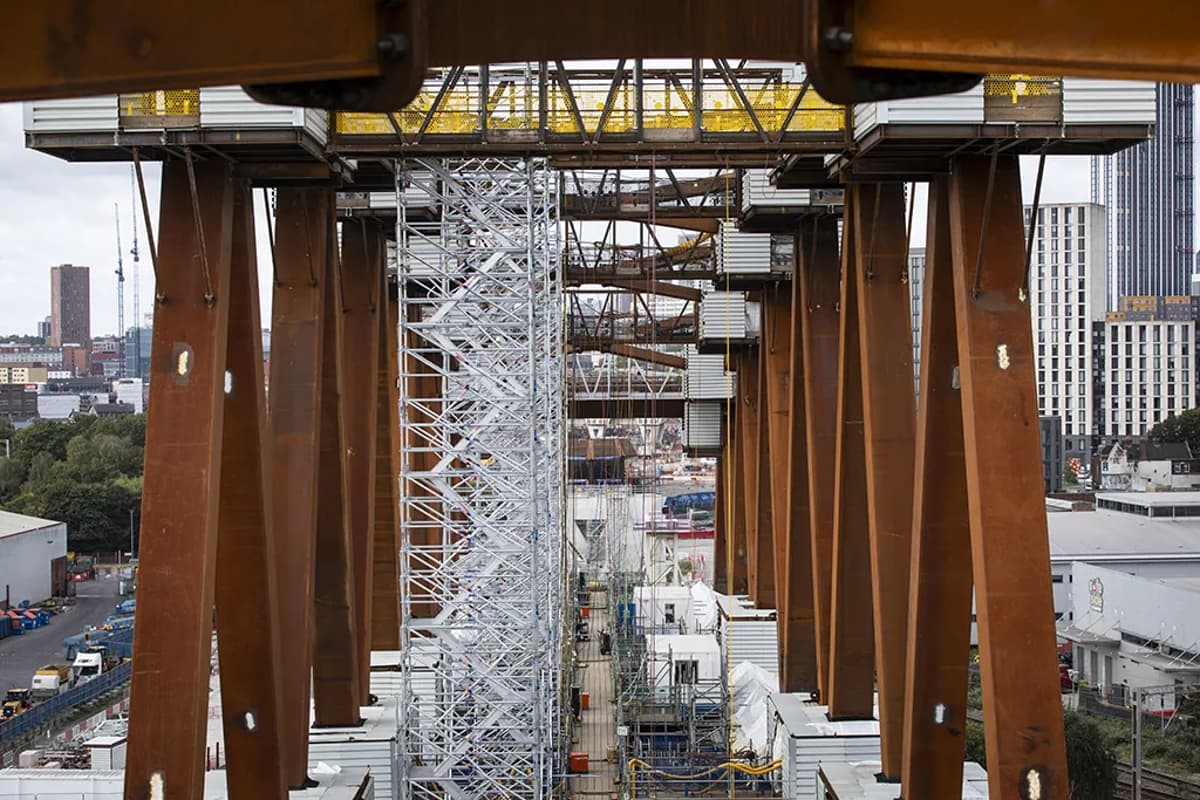
Bridge of Size: Installing HS2’s Tallest Viaduct
Companies Mentioned
Why It Matters
Successfully installing the bridge keeps HS2’s Birmingham approach on schedule and demonstrates the viability of large‑scale, off‑site steel fabrication for future UK rail projects. It also showcases advanced vibration‑control and logistics solutions needed in dense urban environments.
Key Takeaways
- •150 m truss, 40 m high, tallest HS2 viaduct
- •200 utilities diverted; 40 previously unknown
- •12,000 t of steel imported; 10,000 t fabricated locally
- •Launch uses 500‑t hydraulic jacks and custom sliding nose
Pulse Analysis
HS2’s Curzon Street approach hinges on the Bellingham Bridge, a 150‑metre steel Warren‑truss that will become the tallest viaduct on the high‑speed line. The structure’s 4,200 tonnes of weathering steel were largely sourced abroad—about 12,000 tonnes from European mills—while the UK supplied the remainder, highlighting the project’s reliance on cross‑border supply chains. Off‑site fabrication in Portugal and a temporary outdoor factory near the M42 allowed most welding to occur under controlled conditions, boosting efficiency five‑to‑sixfold compared with on‑site work.
The launch operation is a logistical choreography. Engineers must navigate a site hemmed in by an active rail line, the River Rea, a fire station, warehouses, and a museum storing vibration‑sensitive artefacts. Over 200 utilities were rerouted, including 40 that were undocumented until excavation began. A 400‑tonne crawler crane lifted 140‑tonne sections onto a bespoke platform equipped with live vibration sensors, while hydraulic strand jacks—each rated around 500 tonnes—will pull the truss forward in 1.5‑metre increments. The temporary “nose” at the truss front guides the structure onto permanent bearings, mitigating cantilever forces as it slides at a 21‑degree angle over live tracks.
Beyond the engineering feat, the bridge’s timely installation is critical for HS2’s overall delivery timetable and for minimizing disruption to existing rail services. The project’s emphasis on prefabrication, sustainable weathering steel, and rigorous vibration‑mitigation sets a benchmark for future infrastructure works in densely populated corridors. By resolving skilled‑labour shortages through advanced planning and modular construction, HS2 demonstrates a scalable model for large‑scale rail expansions across the United Kingdom.
Bridge of size: Installing HS2’s tallest viaduct
Comments
Want to join the conversation?
Loading comments...