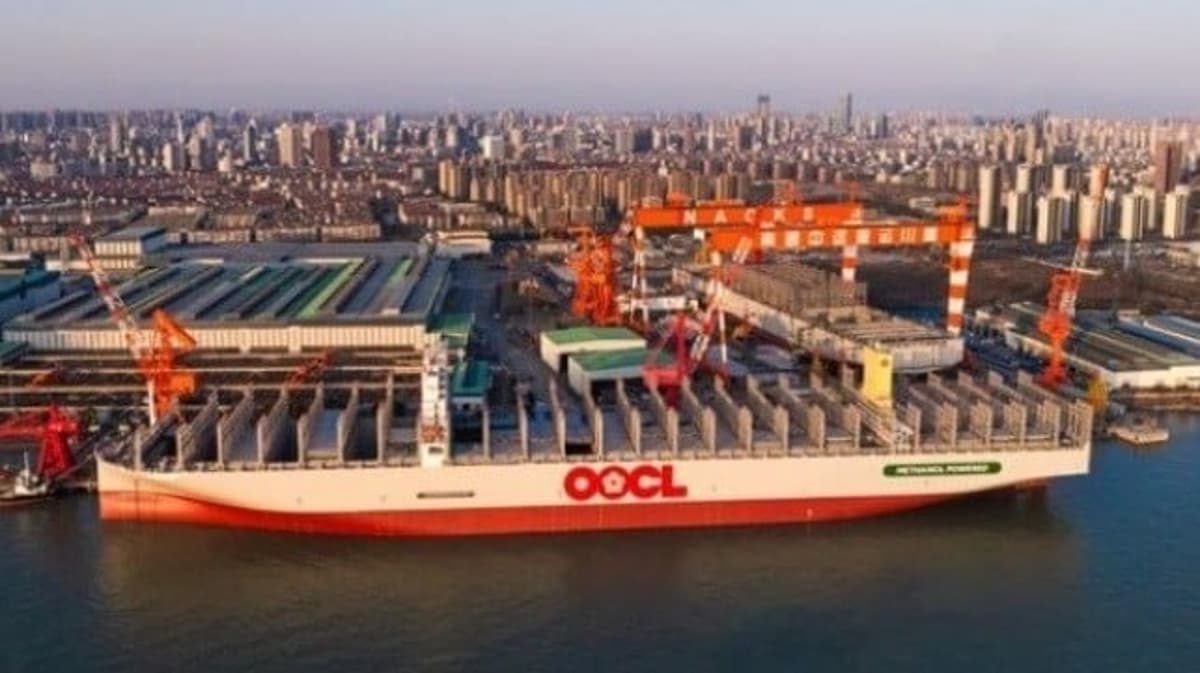
China Names Largest Methanol Dual-Fuel Boxship Expanding Green Shipping
Why It Matters
OOCL Wisdom sets a new capacity benchmark for methanol‑powered vessels, accelerating the shift toward lower‑emission container shipping and giving COSCO a competitive edge in a market seeking sustainable logistics.
Key Takeaways
- •OOCL Wisdom: 24,168 TEU, largest methanol‑fuel container ship.
- •Order of 12 methanol ships valued at ~$2.9 billion.
- •Dual‑fuel propulsion enables 22.7‑knot service speed on methanol.
- •Integrated data platform optimizes speed, trim, and hull fatigue.
- •COSCO leads methanol adoption while rivals scale back.
Pulse Analysis
Methanol is emerging as a viable low‑carbon alternative to heavy fuel oil, driven by stricter IMO emissions targets and growing investor pressure for greener logistics. China’s state‑backed shipping conglomerates have leveraged domestic shipyards and subsidies to accelerate development, positioning themselves ahead of European and North American peers that remain cautious about fuel supply chains. By scaling methanol‑dual‑fuel vessels, COSCO aims to capture a larger share of the ultra‑large container market while reducing the carbon intensity of long‑haul routes between Asia and the United States.
OOCL Wisdom embodies the next generation of green shipping technology. At 399 meters long and 225,000 dwt, its dual‑fuel main, auxiliary engines and boilers can run entirely on methanol, delivering a 22.7‑knot service speed without sacrificing payload. The ship’s onboard intelligent data platform continuously exchanges information with shore, automatically fine‑tuning speed, trim and hull stress to maximize fuel efficiency. These digital controls not only lower operating costs but also extend the vessel’s service life by predicting structural fatigue in real time, a critical advantage for ultra‑large carriers.
The vessel’s debut signals a strategic shift in the container shipping landscape. While Maersk and other Western lines have slowed methanol projects due to infrastructure uncertainty, COSCO’s aggressive rollout of 12 ships—worth nearly $3 billion—creates economies of scale that could spur global methanol supply chains and port refueling facilities. If the technology proves reliable, it may set a new industry standard, prompting rivals to revisit their decarbonization roadmaps and investors to favor carriers with demonstrable low‑carbon assets. The next few years will reveal whether methanol can become the bridge fuel to a fully zero‑emission future.
China Names Largest Methanol Dual-Fuel Boxship Expanding Green Shipping
Comments
Want to join the conversation?
Loading comments...