China’s Electric Concrete Mixer Boom Is A Warning To Slow Heavy Truck Markets
Companies Mentioned
Why It Matters
The Chinese rollout proves that heavy‑duty vehicles with fixed routes can be electrified profitably, offering a template for global construction fleets seeking to cut diesel use, emissions, and operating costs.
Key Takeaways
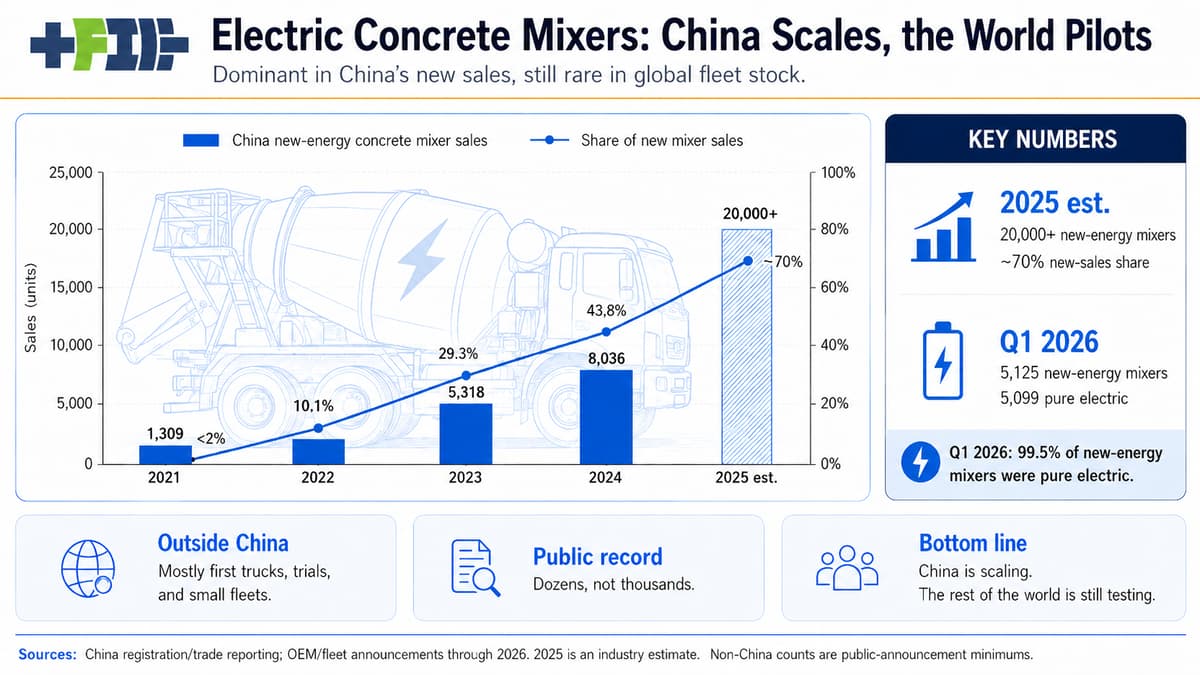
- •China’s electric mixer sales rose from 1,309 (2021) to 8,036 (2024).
- •2026 Q1 showed 99.5% of new mixers were pure battery electric.
- •Battery‑electric mixers benefit from fixed routes and plant‑based charging hubs.
- •Hydrogen trucks lag because mixers’ predictable cycles favor batteries over fuel cells.
- •Outside China, deployments remain pilots, with fleets under a dozen units.
Pulse Analysis
The electrification of heavy‑duty trucks has long been hampered by weight, range, and downtime concerns, and concrete mixers epitomize those challenges. Yet China’s data shows a different story: a vehicle that hauls dense loads but operates on tightly scheduled, short‑range routes from a central batching plant. This predictability lets operators install chargers or battery‑swap stations at the plant, turning a seemingly hard‑to‑electrify asset into a low‑complexity, high‑utilisation electric fleet. The result is a rapid climb from a niche segment to a mainstream procurement category within five years.
Three forces converged to accelerate the Chinese boom. First, domestic truck OEMs and battery manufacturers aligned their product roadmaps, delivering purpose‑built electric mixers with integrated drum drives. Second, policy levers—urban air‑quality mandates, subsidies, and low‑emission construction zone rules—created market pull while encouraging infrastructure investment at plant sites. Third, China’s experience with heavy‑duty battery swapping provided a proven model for minimizing vehicle downtime, especially where fleets run dozens of mixers from a single hub. Together, these elements reduced total cost of ownership, mitigated range anxiety, and demonstrated a clear economic case for diesel replacement.
For markets outside China, the lesson is not to copy subsidies verbatim but to replicate the alignment of vehicle design, route certainty, and localized charging. Fleet operators should pilot electric mixers on routes with known distances, ample dwell time at plants, and repeatable demand, using the pilots to refine energy consumption, drum power needs, and winter performance. Policymakers can accelerate adoption by earmarking funds for plant‑side grid upgrades, simplifying permitting for on‑site chargers, and setting low‑emission procurement standards for public construction projects. While hydrogen may still have a role in long‑haul heavy trucks, concrete mixers—by virtue of their bounded duty cycles—are best served by battery power, a conclusion reinforced by China’s near‑total shift away from fuel‑cell alternatives.
China’s Electric Concrete Mixer Boom Is A Warning To Slow Heavy Truck Markets
Comments
Want to join the conversation?
Loading comments...