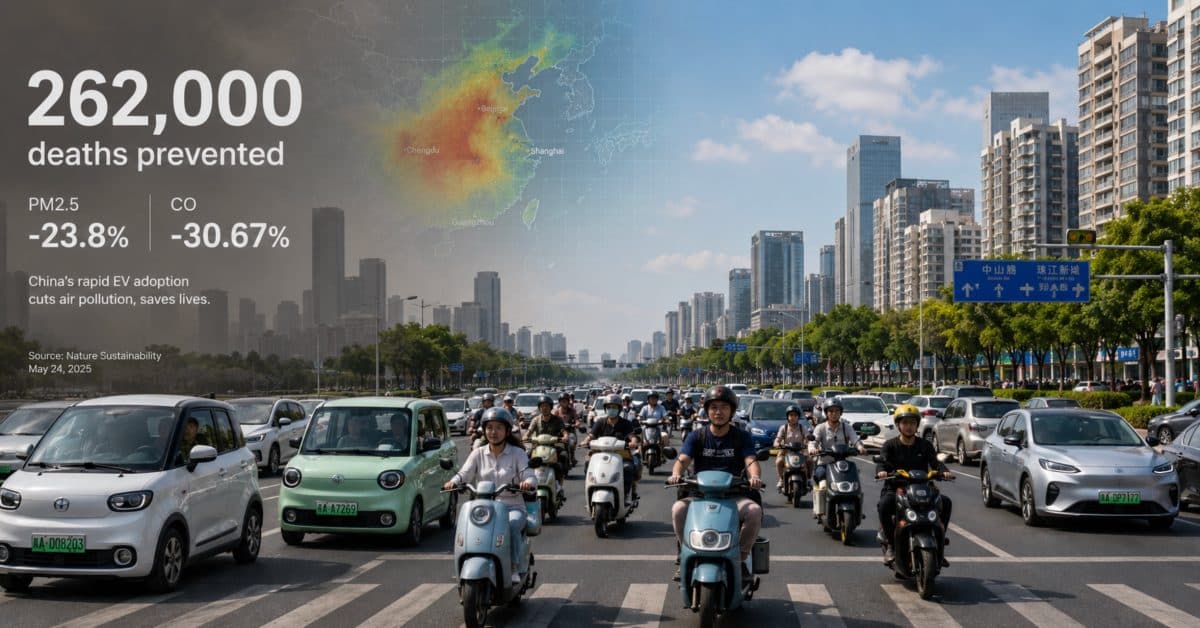
China’s EV Shift Cut Pollution Enough to Prevent 262,000 Deaths
Why It Matters
The findings prove that large‑scale EV adoption can deliver measurable health outcomes now, shaping policy priorities for cleaner transport and highlighting remaining pollution sources that need attention.
Key Takeaways
- •NEV adoption cut PM2.5 by 23.8%, saving 262,000 lives
- •CO fell 30.7%; NO₂ dropped only 1.81 µg/m³
- •Benefits concentrated in wealthy Chinese cities; poorer regions lag
- •Heavy‑duty diesel trucks remain major source of NO₂ and coarse particles
- •China sold 231,000 electric/hybrid semi‑trucks in 2025
Pulse Analysis
The Nature Health paper leverages high‑resolution satellite data and machine‑learning models to compare actual 2023 pollution levels with a counterfactual world where every vehicle still runs on gasoline or diesel. By isolating the impact of new‑energy vehicles—battery‑electric, plug‑in hybrids and hydrogen models—the researchers quantified a 23.8% drop in PM2.5 and a 30.7% reduction in carbon monoxide, translating into roughly 262,000 avoided premature deaths. This methodological rigor moves the EV debate from projected climate benefits to concrete, real‑world health outcomes.
Policy implications are immediate. While the study celebrates the health gains, it also flags the pollutants that barely budged—nitrogen dioxide and coarse particles—largely emitted by heavy‑duty diesel trucks that remain under‑electrified. The uneven distribution of benefits, favoring affluent coastal megacities, signals a need for targeted incentives to accelerate NEV uptake in lower‑income regions and to fast‑track electric and hybrid semi‑truck deployments, which already reached 231,000 units in 2025. Addressing these gaps could amplify the mortality reduction and bring cleaner air to a broader swath of the population.
Globally, China’s experience offers a template for other markets. A parallel study in California showed measurable NO₂ declines linked to zero‑emission vehicle registrations, reinforcing that the health case for electrification is universal. While the climate argument for EVs remains vital, the immediacy of air‑quality improvements provides a compelling narrative for policymakers confronting public‑health pressures. As nations weigh subsidies, grid decarbonization, and vehicle standards, the Chinese data demonstrate that even a coal‑heavy grid can yield net health benefits when vehicle emissions are sharply reduced, making the "where does the electricity come from" objection less persuasive.
China’s EV shift cut pollution enough to prevent 262,000 deaths
Comments
Want to join the conversation?
Loading comments...