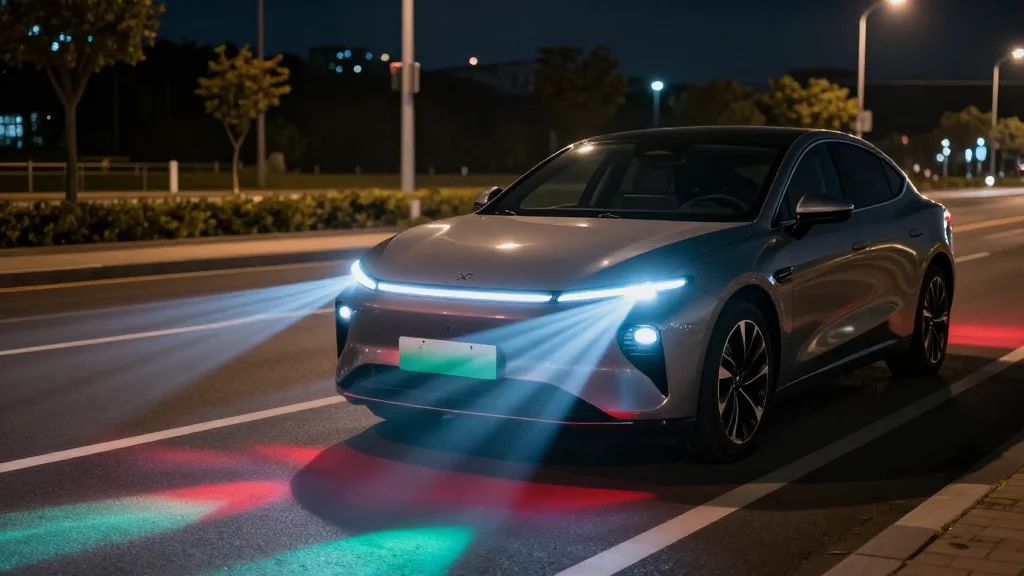
Chinese EVs Can Now Project Entire Movies From Their Headlights
Companies Mentioned
Why It Matters
The development underscores China's rapid lead in automotive lighting and in‑car entertainment, pressuring U.S. manufacturers and regulators to accelerate similar innovations. It could redefine safety and user experience standards across the EV industry.
Key Takeaways
- •Huawei's XPixel headlights project full-color movies from car front
- •Projection integrated with driver-assistance for lane guidance and pedestrian cues
- •New XPixel version debuting in Aito M9 and upcoming models
- •US only recently approved adaptive headlights, lagging behind China
- •Chinese EVs deliver advanced tech at lower cost than rivals
Pulse Analysis
The automotive lighting landscape is undergoing a paradigm shift, driven by advances in solid‑state optics and high‑resolution projection. Huawei's XPixel system leverages laser‑based light engines and AI‑controlled mirrors to render vivid, full‑color images on any surface ahead of the vehicle. By embedding this capability within existing driver‑assistance frameworks, manufacturers can simultaneously enhance safety—showing lane‑change paths or pedestrian crossing cues—and create novel infotainment experiences. This convergence of illumination and digital display marks a departure from traditional headlamp functions, positioning lighting as a multifunctional interface.
From a market perspective, the ability to turn a car into a mobile cinema offers a compelling differentiator for Chinese EV brands that compete on price and feature density. Early adopters such as the Aito M9 will likely attract tech‑savvy consumers seeking immersive experiences, while also opening new revenue streams through licensed content or advertising partnerships. In the United States, regulatory inertia has delayed adaptive beam deployment, leaving domestic automakers trailing in both safety and entertainment innovation. As U.S. regulators revisit Federal Motor Vehicle Safety Standards, Chinese manufacturers may gain a foothold in premium segments by bundling advanced lighting with their broader ADAS suites.
Looking ahead, the projection‑enabled headlamp could evolve into a platform for over‑the‑air updates, dynamic navigation cues, and vehicle‑to‑infrastructure communication. Automakers worldwide may adopt similar systems to meet rising consumer expectations for personalization and safety integration. However, challenges remain around eye‑safety standards, glare management, and data privacy for interactive content. If these hurdles are addressed, full‑color projection headlights could become a staple of next‑generation EVs, reshaping how drivers interact with their vehicles and the road environment.
Chinese EVs Can Now Project Entire Movies From Their Headlights
Comments
Want to join the conversation?
Loading comments...