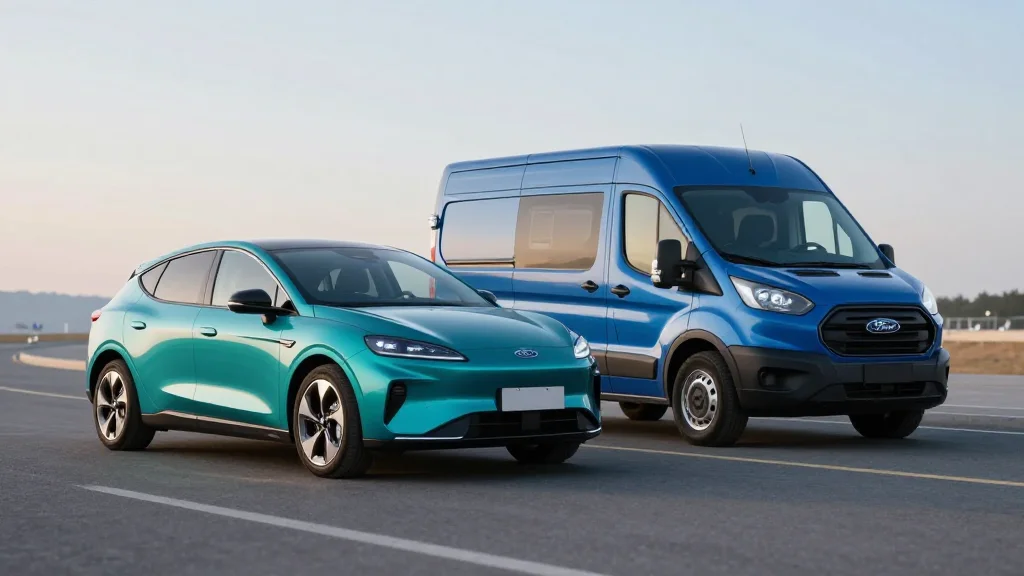
Detroit's Great Divide: Two Titans, Two Paths to Profit
Companies Mentioned
Why It Matters
The divergent strategies illustrate how legacy automakers can either leverage international technology alliances or reinforce core cash‑flow businesses to navigate the EV transition, shaping investor risk‑reward calculations and industry competition.
Key Takeaways
- •Stellantis secures 21% stake in Leapmotor for cheap EV platform.
- •Stellantis trades at forward P/E 3.26, far below sector average.
- •Ford’s Pro commercial unit funds EV development with strong cash flow.
- •Ford offers 4.93% dividend, appealing to value‑oriented investors.
- •Two Detroit titans present contrasting risk‑reward profiles for investors.
Pulse Analysis
The electric‑vehicle market is entering a phase of disciplined growth, with higher interest rates and more selective buyers forcing manufacturers to prove profitability, not just volume. Stellantis’ partnership with Leapmotor gives it immediate access to a mature, cost‑effective battery architecture that has already delivered over 100,000 units in China. By acquiring a 21% equity stake, Stellantis sidesteps the lengthy R&D cycle, positioning itself for a rapid price‑competitive rollout in North America and Europe. The market’s undervaluation of this strategy—evidenced by a forward P/E of just 3.26 and a near‑10% dividend—signals upside potential for investors willing to accept execution risk.
Ford’s playbook is rooted in leveraging its dominant commercial vehicle franchise. The Ford Pro segment, encompassing F‑Series trucks and Transit vans, generates consistent cash flow that underwrites the company’s EV ambitions without jeopardizing short‑term earnings. This internal financing model reduces reliance on external partnerships and mitigates exposure to supply‑chain volatility. Coupled with a 4.93% dividend and recent insider buying, Ford presents a classic blue‑chip profile, appealing to value‑focused investors who prioritize steady returns over speculative upside.
For the broader auto industry, the contrast between Stellantis’ aggressive global tech acquisition and Ford’s cash‑flow‑driven stability underscores a strategic inflection point. Companies must decide whether to chase rapid market share through external innovation or to fund the transition organically from existing profit centers. The outcome will influence capital allocation trends, supplier dynamics, and the pace at which affordable EVs reach mainstream consumers, ultimately shaping the competitive landscape for the next decade.
Detroit's Great Divide: Two Titans, Two Paths to Profit
Comments
Want to join the conversation?
Loading comments...