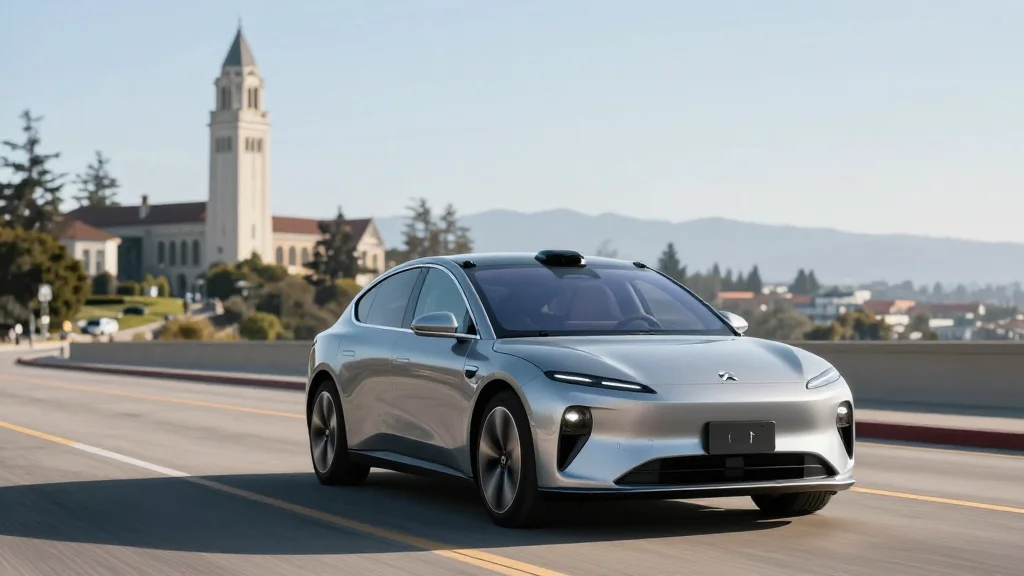
Dreame Nebula NEXT Auto Teams with UC Berkeley to Accelerate AI‑Defined Vehicles

Why It Matters
The Dreame Nebula NEXT–UC Berkeley collaboration could accelerate the transition from software‑defined to AI‑defined vehicles, a shift that promises more adaptive, safety‑centric autonomous driving. By embedding high‑performance AI directly into vehicle control loops, manufacturers can reduce latency, improve decision‑making in edge cases, and potentially lower the cost of sensor suites through smarter data processing. If Nebula NEXT can validate its AI‑native architecture at scale, it may force traditional OEMs to rethink their development roadmaps, spurring further investment in AI research partnerships and prompting regulators to update safety frameworks for vehicles that learn and evolve post‑deployment.
Key Takeaways
- •Dreame Nebula NEXT Auto deepens partnership with UC Berkeley to fast‑track AI‑defined vehicle tech.
- •Jake Ma emphasizes the car as a "physical mothership" for large AI models.
- •Nebula NEXT 01 hyper‑sedan boasts 0‑100 km/h in 1.8 seconds and >2,000 hp.
- •Upcoming Silicon Valley event on April 27 will showcase Berkeley‑inspired prototypes.
- •Collaboration reflects industry shift toward AI‑native vehicle architectures.
Pulse Analysis
Dreame Nebula NEXT's alliance with UC Berkeley is more than a PR move; it signals a tactical response to the escalating computational demands of autonomous driving. Historically, automakers have relied on incremental sensor upgrades and incremental software patches. Nebula NEXT is attempting a paradigm shift by treating the vehicle as a high‑density compute platform, akin to a data center on wheels. This approach could compress the development cycle for advanced driver‑assistance systems (ADAS) and full autonomy, giving the startup a competitive edge over incumbents still anchored in legacy ECUs.
However, the path is fraught with challenges. Scaling AI models from lab prototypes to production vehicles requires robust validation pipelines, supply‑chain resilience for specialized chips, and regulatory buy‑in for systems that continuously learn post‑sale. Nebula NEXT's success will hinge on its ability to demonstrate reproducible safety outcomes and cost‑effective manufacturing. The upcoming April 27 showcase will be a litmus test: if the prototypes can prove real‑world reliability, investors may pour capital into similar AI‑centric ventures, accelerating an industry‑wide pivot toward AI‑defined mobility.
In the broader market, this partnership could catalyze a wave of university‑industry collaborations, especially as universities like Berkeley possess deep expertise in control theory, reinforcement learning, and high‑performance computing. Automakers that fail to secure such academic pipelines risk falling behind in the race to deliver truly autonomous, AI‑driven vehicles at scale.
Dreame Nebula NEXT Auto Teams with UC Berkeley to Accelerate AI‑Defined Vehicles
Comments
Want to join the conversation?
Loading comments...