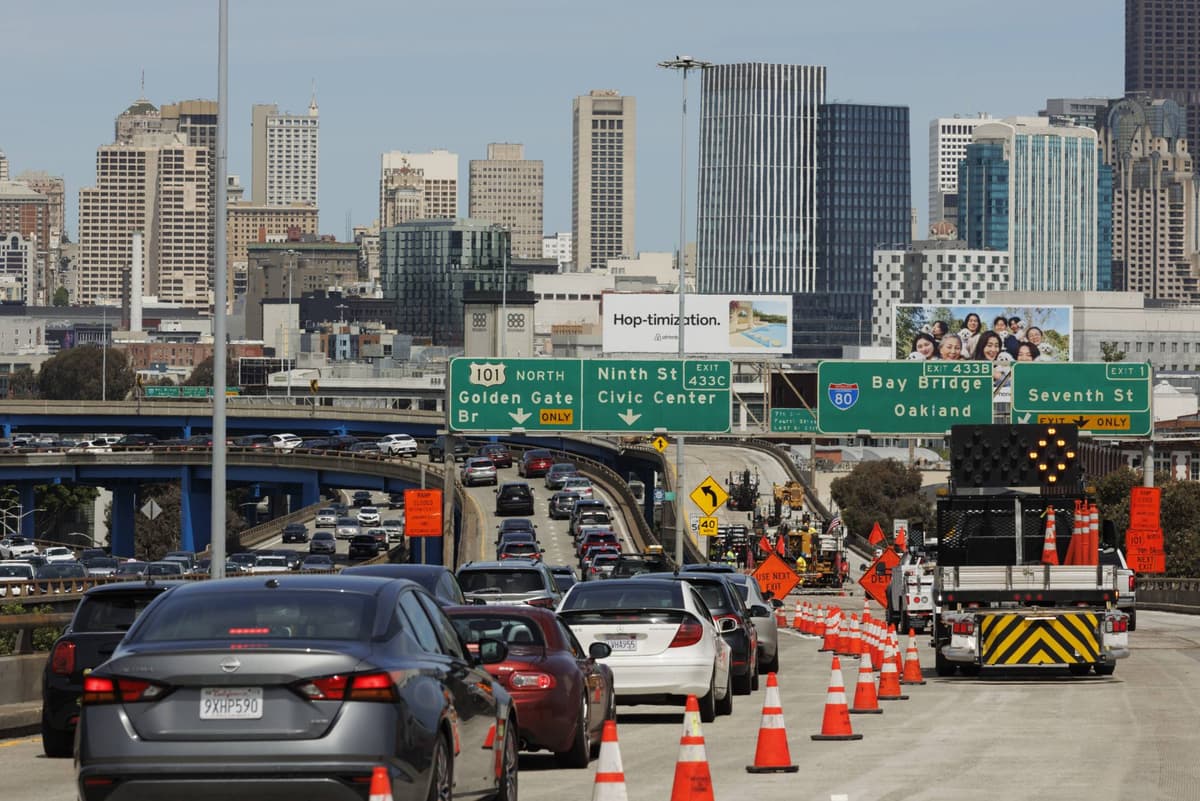
Empty I-80 Allows Caltrans to Repair Key San Francisco Bay Bridge Connector
Why It Matters
The repair prolongs the Bay Bridge connector’s service life, reducing future pothole repairs and improving safety for a critical commuter route. It also showcases how targeted weekend closures can minimize disruption while addressing California’s aging infrastructure.
Key Takeaways
- •Over 100 Caltrans workers resurfaced I‑80 corridor over weekend
- •Poly‑overlay adds inch‑thick layer to extend bridge deck lifespan
- •Closure rerouted traffic to US‑101, prompting public transit use
- •Projected ten‑year durability reduces future pothole repairs
- •Weekend work avoids peak‑hour disruptions for commuters
Pulse Analysis
The eastbound stretch of Interstate 80 that links US‑101 to the San Francisco‑Oakland Bay Bridge is one of the Bay Area’s most heavily trafficked arteries, moving tens of thousands of vehicles daily. By closing the corridor for a weekend in April 2026, Caltrans seized a rare lull in commuter flow to conduct extensive resurfacing without the usual peak‑hour congestion. Over 100 crews operated in parallel, rerouting traffic onto US‑101 and city streets while urging riders to switch to public transit, thereby minimizing disruption to the region’s economy.
The project employed a poly‑overlay, an engineered polymer‑modified asphalt layer roughly an inch thick applied over the existing deck. This technique bonds to the old surface, sealing cracks and creating a smoother ride while extending the pavement’s service life by an estimated ten years. Engineers cite the overlay’s resistance to water infiltration and thermal stress as key factors that reduce future pothole formation. By completing the work in a single, continuous weekend, Caltrans avoided the incremental costs and traffic delays associated with staged repairs.
Beyond the immediate benefits to commuters, the “Fab Rehab” reflects California’s broader push to modernize aging infrastructure with cost‑effective, low‑disruption methods. The successful weekend closure demonstrates how strategic timing and robust public‑information campaigns can encourage transit use, easing congestion and emissions. As the state confronts a multibillion‑dollar backlog of bridge and roadway projects, replicating this approach could accelerate rehabilitation timelines, preserve critical links like the Bay Bridge connector, and bolster the region’s resilience against future wear.
Empty I-80 Allows Caltrans to Repair Key San Francisco Bay Bridge Connector
Comments
Want to join the conversation?
Loading comments...